
During a maturity assessment at a mid-sized retailer, auditors find that the security team collects minimal endpoint telemetry, performs no proactive queries, and relies exclusively on out-of-the-box vendor alerts. Which Threat Hunting Maturity Model level describes this posture?
Select an answer to reveal the explanation.
Short Explanation
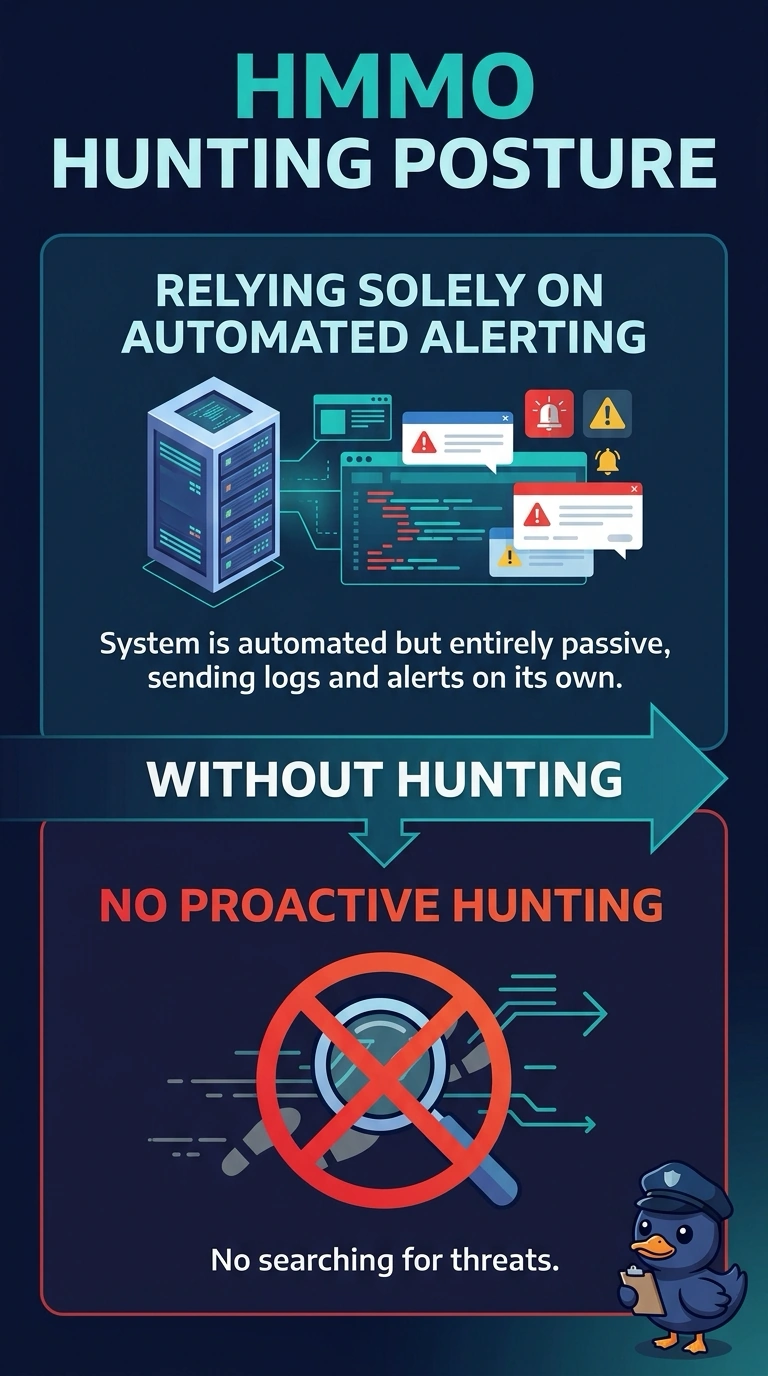
When a security team only reacts to whatever pops up on a vendor dashboard, they are sitting at the starting line of the maturity model. Your clue is the lack of both broad telemetry and proactive queries, whereas the trap is picking a higher level where teams already hunt.
Full Explanation
HMM0, where the organization relies solely on automated alerting without hunting is correct because the baseline stage of the Threat Hunting Maturity Model describes teams with little or no centralized data collection that depend entirely on automated security tools to surface incidents. HMM1, where analysts run occasional ad-hoc searches on centralized logs fails because HMM1 requires moderate data collection and analysts manually searching for indicators rather than relying exclusively on vendor alerts. HMM2, where teams execute routine hunts driven by published threat intel fails because HMM2 presupposes high data collection and repeatable, intelligence-driven hunting procedures. HMM4, where validated hunts are fully automated into continuous detections fails because HMM4 sits at the top of the model, where mature teams continuously automate successful hunting analytics. As a caveat, an organization at HMM0 should prioritize centralizing endpoint and network telemetry before attempting advanced hypothesis-driven hunts, since hunters cannot query data that is never collected. For an operational check, inventory your current log sources against critical internal subnets to confirm baseline telemetry coverage before scheduling your first structured hunt.