
A threat intelligence analyst needs to catalog recurring software exploitation patterns against a custom web application alongside post-compromise adversary tactics observed on internal servers. Which pairing accurately distinguishes the purpose of CAPEC from MITRE ATT&CK?
Select an answer to reveal the explanation.
Short Explanation
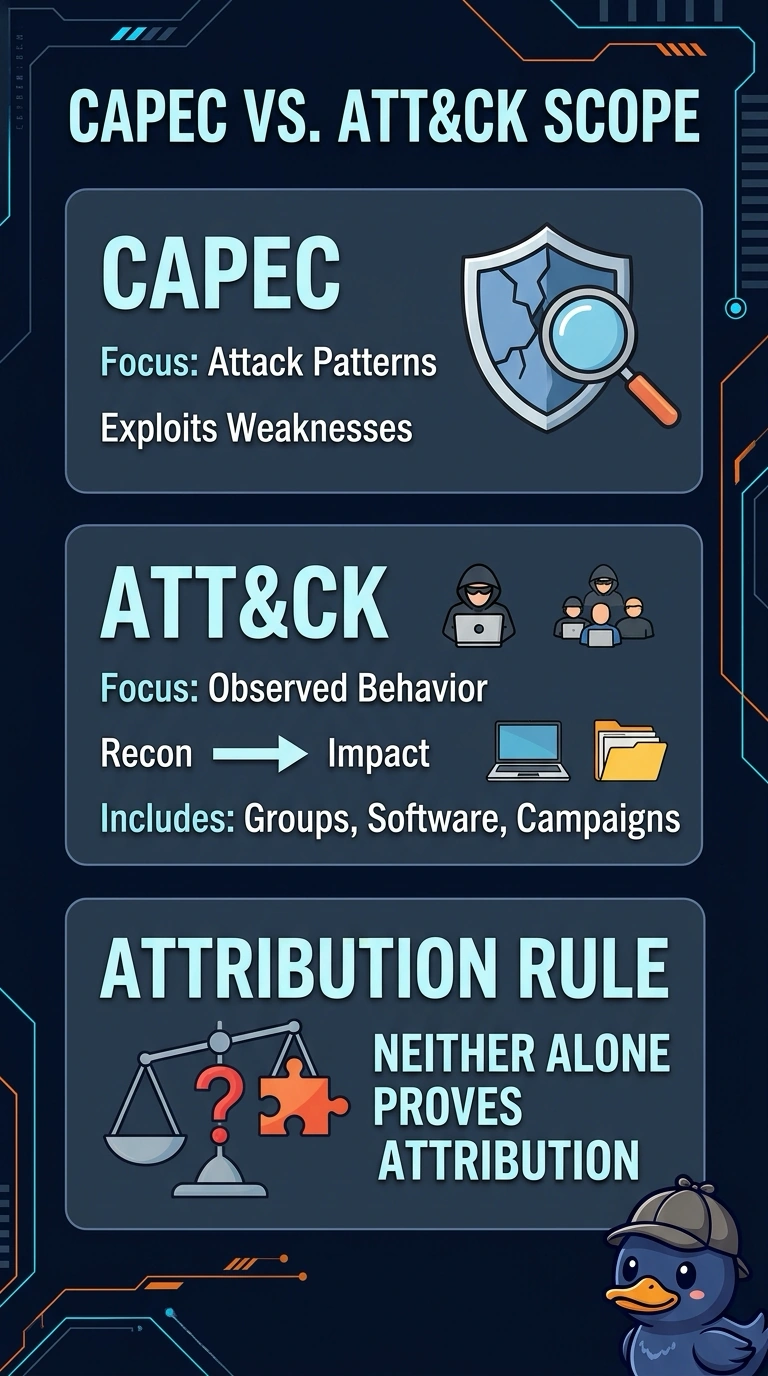
You can remember the scope like this: CAPEC catalogs attack patterns exploiting weaknesses in cyber-enabled capabilities; ATT&CK catalogs observed adversary behavior from reconnaissance through impact and includes groups, software, and campaigns. Neither framework alone proves attribution, so you should never use either alone to name the attacker.
Full Explanation
Selecting "CAPEC catalogs attack patterns exploiting weaknesses in cyber-enabled capabilities; ATT&CK catalogs observed adversary behavior from reconnaissance through impact and includes groups, software, and campaigns. Neither framework alone proves attribution." is correct because it captures the distinct MITRE scopes. CAPEC shows how weaknesses in cyber-enabled capabilities can be exploited, supporting application threat modeling and design review. ATT&CK organizes observed adversary behavior from reconnaissance through impact into tactics, techniques, and procedures with context on groups, software, and campaigns for detection and monitoring. Neither framework alone proves attribution, so more intelligence is needed for responsibility. The claim pairing threat actor attribution profiles with vulnerability severity is incorrect because attribution belongs to actor tracking and severity scoring belongs to systems like CVSS. The claim pairing step-by-step incident response playbooks with automated endpoint containment is incorrect because both CAPEC and ATT&CK are descriptive references, not playbooks or containment tools. The claim pairing network sensor maturity levels with indicator volatility ranking is incorrect because maturity comes from hunting maturity models and volatility comes from the Pyramid of Pain.