
A retail enterprise relies heavily on automated signature-based alerts, yet an intruder operates undetected for weeks using built-in administrative utilities and valid credentials. Why do signature-based detection tools struggle to flag this activity on their own?
Select an answer to reveal the explanation.
Short Explanation
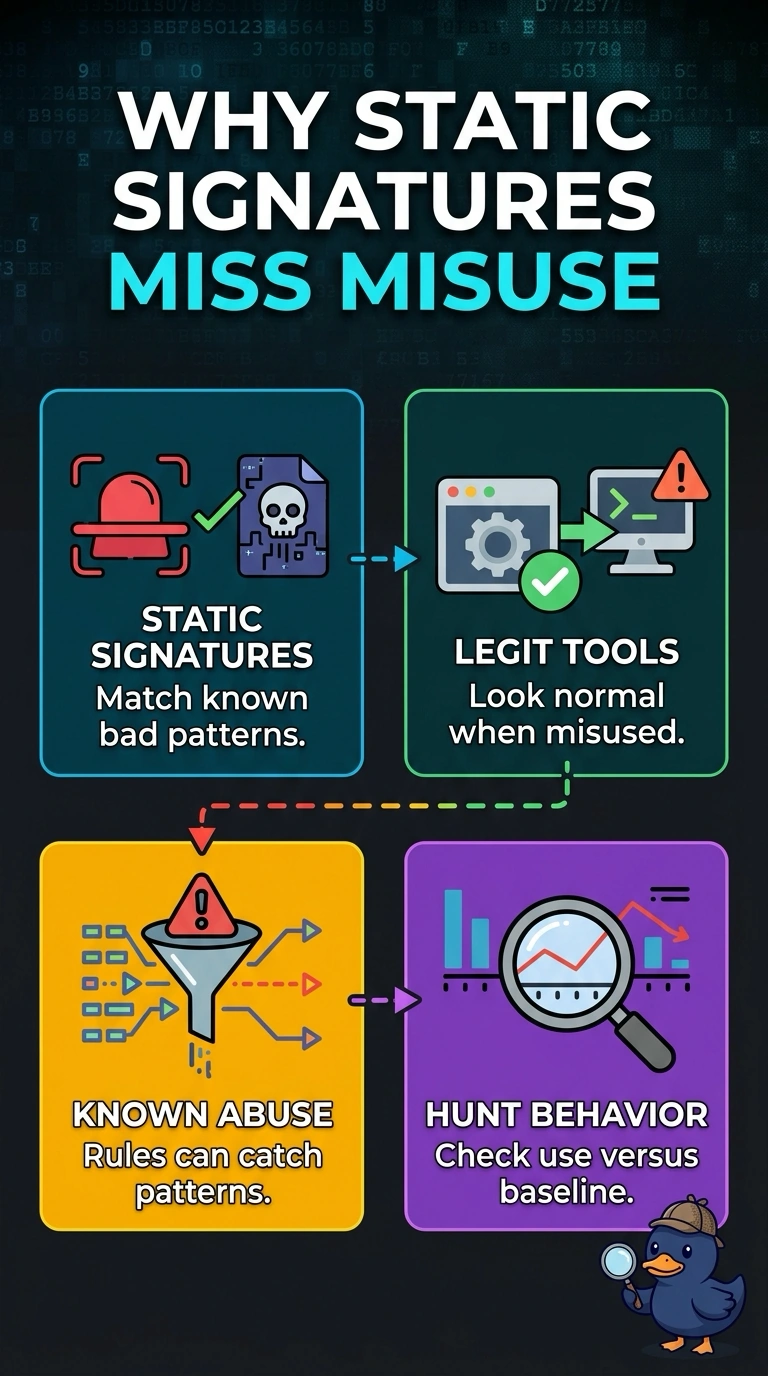
Signature tools work like a guard checking faces against a wanted poster: if an intruder wears a staff badge and uses company tools, the poster never triggers. You need behavioral hunting alongside signatures because static rules look for known bad artifacts rather than legitimate utilities used with malicious intent. The trap is blaming encryption or disabled admin logging when the real gap is the lack of behavioral context.
Full Explanation
Automated signature-based detection relies on predefined indicators such as known file hashes, byte sequences, or explicit exploit strings. Because Static indicator signatures can miss malicious use of legitimate administrative tools, living-off-the-land activity blends into normal administrative traffic and avoids triggering static alerts. Signature and deterministic behavior rules can detect known command patterns or tool abuse; living-off-the-land execution is not inherently invisible to all signature engines. By contrast, claiming that Signature engines only inspect encrypted payloads after decryption at the perimeter misstates how host and network sensors operate, since endpoint agents observe local process execution directly regardless of perimeter encryption. Claiming that Automated tools cannot correlate events across different network subnets is also inaccurate, as modern SIEM and centralized platforms routinely aggregate multi-subnet telemetry. Likewise, claiming that Endpoint sensors disable rule evaluation whenever administrative accounts log in describes a non-existent default, because sensors continue monitoring privileged sessions even when rules lack behavioral context. For an operational check, review recent privileged utility executions in endpoint process logs against approved change tickets to establish a baseline for abnormal usage.