
A university SOC deploys a machine learning anomaly detection module to flag unusual lateral authentication behavior. Six months later, false positives surge after a campus-wide identity migration. What does this illustrate about AI and ML in the SOC?
Select an answer to reveal the explanation.
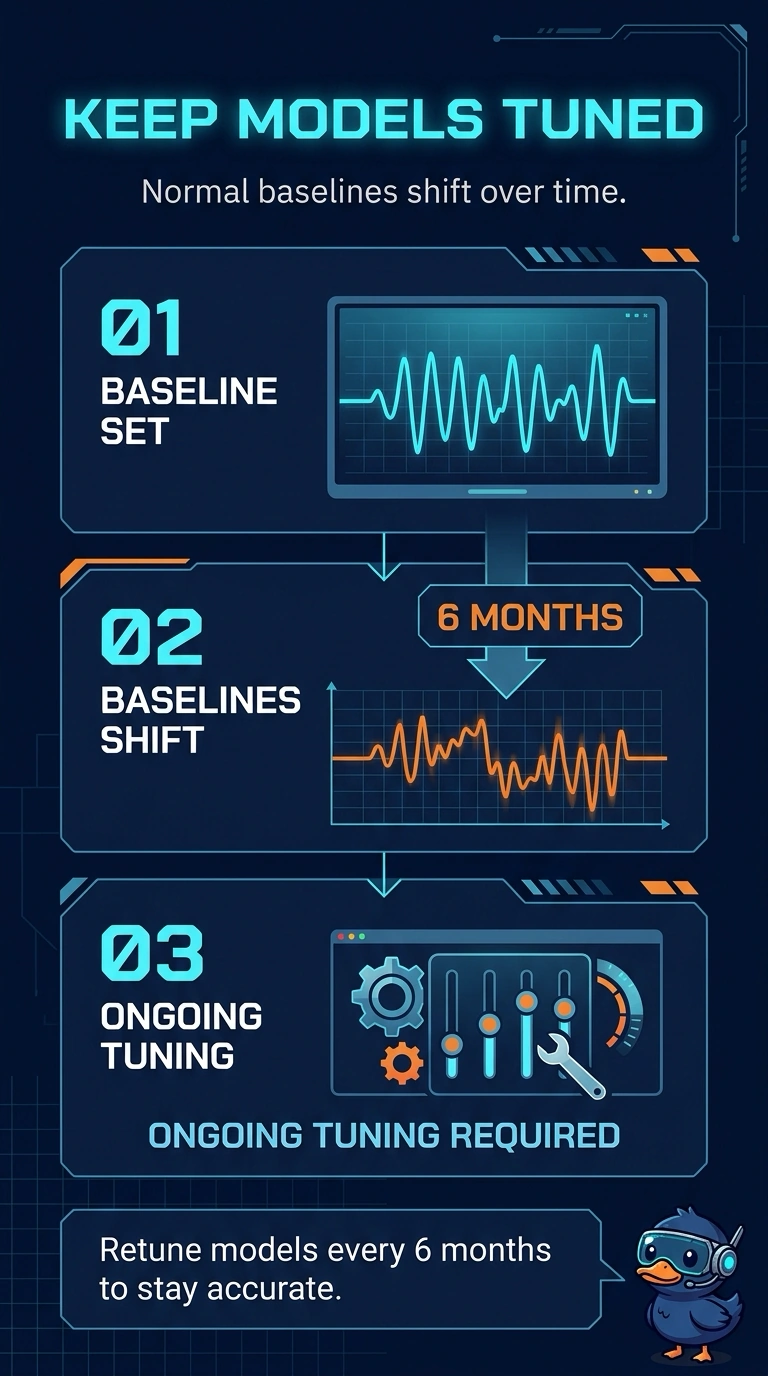
Short Explanation
Machine learning isn't a 'set it and forget it' security appliance—it learns what normal looks like, and normal never stands still. When your environment changes, your models need retraining and tuning, or you'll drown in false alarms.
Full Explanation
It requires ongoing tuning as normal baselines shift is correct because statistical and machine learning models rely on historical behavioral baselines; major infrastructure changes, new applications, or seasonal workflows alter those baselines and cause model drift unless analysts retrain and tune thresholds. It eliminates the need for any human analyst triage is false because ML outputs require expert validation to separate benign operational changes from genuine threats. It guarantees zero false negatives on novel attacks is incorrect because adversaries can blend into normal traffic patterns or mimic legitimate administrative behavior to evade anomaly thresholds. It replaces centralized log collection and correlation is wrong because Reliable analytics require suitable input quality and coverage; telemetry may be processed centrally, on endpoints, or in distributed systems. ML does not replace the collection needed for this SOC’s detections. As a caveat, retraining a model on unverified production data without filtering out active compromises can inadvertently teach the model to treat malicious behavior as normal. As an operational check, schedule quarterly model reviews and re-baseline thresholds after any major identity, cloud, or network architecture change.