
An enterprise security architect wants a threat modeling methodology that connects business impact objectives directly to technical attack simulations and risk mitigation. Which framework best fits this goal?
Select an answer to reveal the explanation.
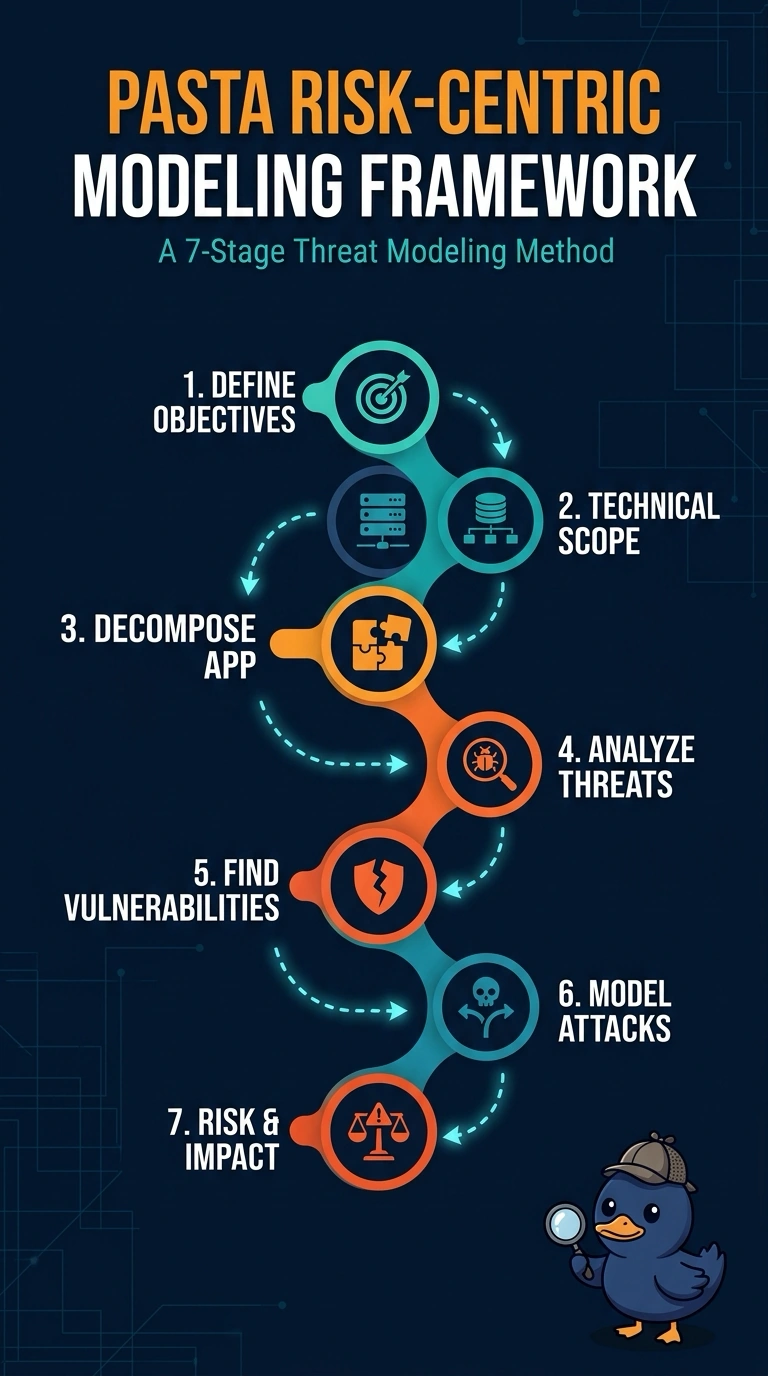
Short Explanation
Think of threat modeling like building a house: you start with what matters most to the family before choosing locks. PASTA aligns business impact with technical attack analysis. The trap is picking a behavior catalog or hunting workflow instead of a risk-centric modeling process.
Full Explanation
The PASTA risk-centric modeling framework is a seven-stage methodology designed to align business objectives and compliance requirements with technical threat identification, vulnerability analysis, and attack simulation. By anchoring defensive priorities to business impact, teams focus controls where risk is highest. The MITRE ATT&CK adversarial behavior matrix catalogs real-world adversary tactics and techniques for detection engineering and adversary emulation, rather than providing an end-to-end business risk modeling process. The TaHiTI threat-hunting methodology structures intelligence-driven threat hunts in a SOC, not application or architectural risk modeling. The CAPEC attack pattern enumeration catalog lists common software exploitation patterns, serving as a reference taxonomy rather than a risk-centric modeling lifecycle. One caveat is that PASTA requires cross-functional collaboration between security engineers and business stakeholders, which can slow adoption if scope is not bounded. As an operational check, verify that your threat model explicitly maps high-value business assets to plausible threat scenarios before selecting technical countermeasures.