
While reviewing endpoint process-creation logs across several branch servers, a threat hunter sees repeated syntax errors followed by adjusted command-line flags and targeted queries for specific finance shares. What does this log pattern most strongly indicate?
Select an answer to reveal the explanation.
Short Explanation
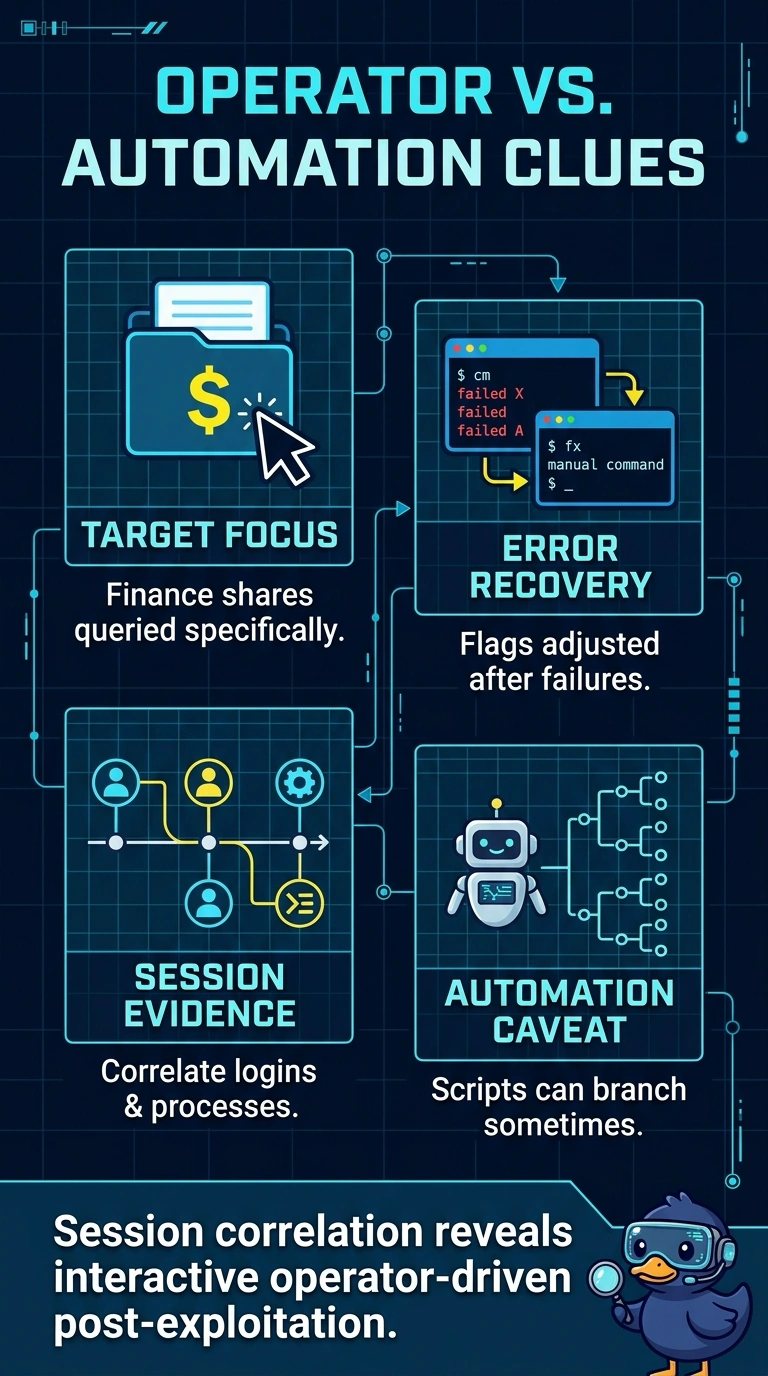
When you see mistyped commands get corrected and then pivot to finance shares, you are likely seeing operator-driven activity you must validate. Adaptive command corrections can suggest an interactive operator, but scripts and AI-assisted automation can also branch on errors; correlate session and execution evidence before inferring human control. Don't dismiss those typos as a scanner glitch — you can spot intruders early by checking the full session.
Full Explanation
Adaptive command corrections can suggest an interactive operator, but scripts and AI-assisted automation can also branch on errors; correlate session and execution evidence before inferring human control. Observing real-time syntax-error recovery with adjusted flags followed by targeted finance-share enumeration points to Activity consistent with interactive operator-driven post-exploitation, requiring session correlation, because the sequence shows reading of error output, adaptation, and steering toward high-value business targets consistent with Command and Scripting Interpreter activity. Treating the activity as Automated commodity worm propagation executing a fixed hardcoded script loop overlooks the feedback-driven correction and focused discovery rather than identical repetition across hosts. Assuming it is A misconfigured vulnerability scanner running standard unauthenticated checks fails to explain targeted share queries rather than broad port or service sweeps. Dismissing the events as Normal scheduled backup software indexing shared directories for archiving ignores trial-and-error shell behavior and error-driven adjustment that backup agents do not normally show. As an operational check, correlate these command-line events with authentication and session logs to identify the source host and user account driving the session.