
During an intrusion investigation at an aerospace contractor, an analyst finds malware containing Cyrillic strings and filenames matching a well-known nation-state group, yet the post-exploitation commands and infrastructure differ completely from that group's history. How should the analyst interpret these surface artifacts?
Select an answer to reveal the explanation.
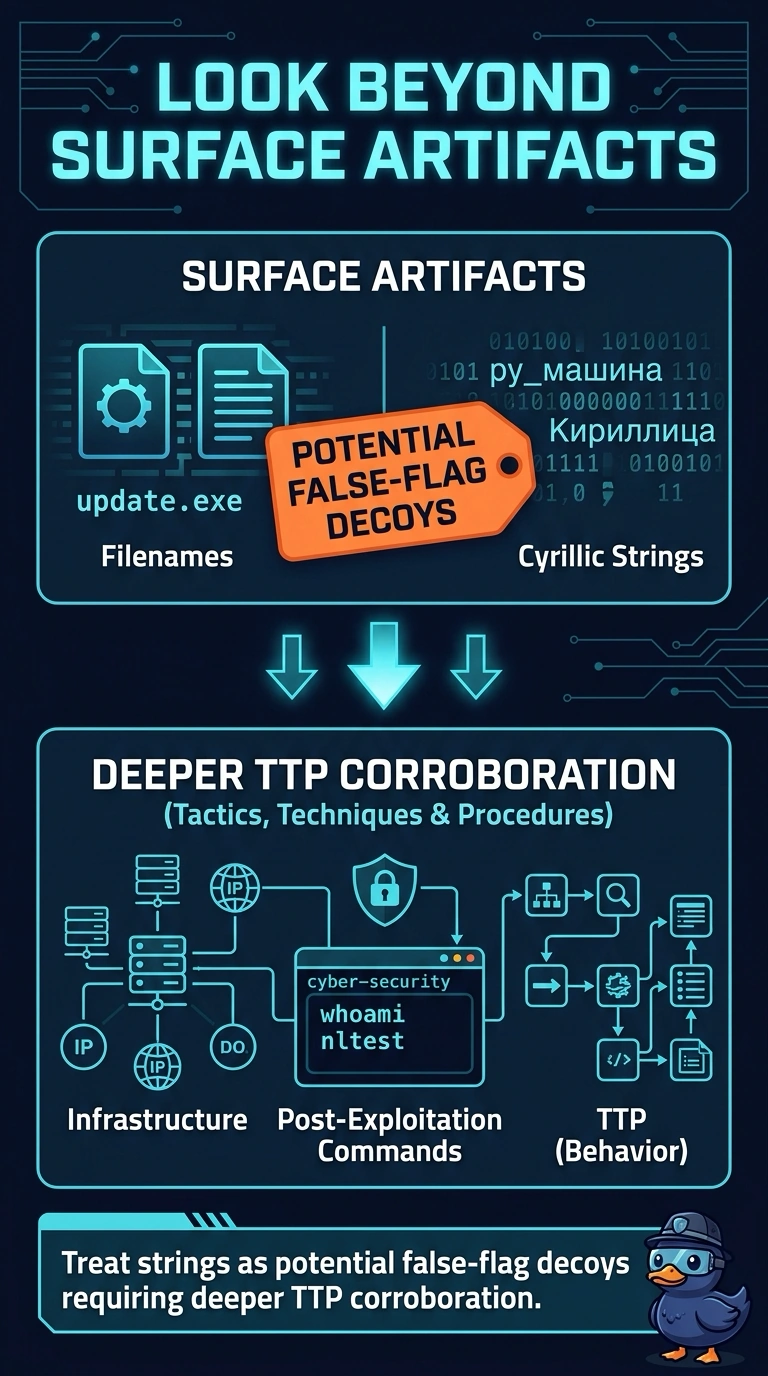
Short Explanation
Think of a burglar leaving someone else's business card at the scene—surface clues are cheap to forge. If you stop at language strings or filenames, you walk straight into a false-flag trap instead of following the adversary's actual behavior.
Full Explanation
Sophisticated adversaries routinely plant false-flag artifacts—such as foreign language strings, recycled tool names, or mimicked file paths—to mislead defenders and complicate attribution. Therefore, analysts must Treat the strings as potential false-flag decoys requiring deeper TTP corroboration across execution workflows, persistence mechanisms, and command-and-control patterns. Choosing to Attribute the intrusion to the named nation-state group based on the unique binary strings falls directly for surface-level deception, because strings are trivial to alter or copy. Choosing to Conclude the compromise was an automated opportunistic worm rather than a targeted actor ignores the deliberate post-exploitation activity observed in the environment. Choosing to Ignore the post-exploitation behavior because compiled binary strings are immutable is backwards: binary strings can be modified at build time, whereas operational tradecraft is much harder to fake consistently. As a caveat, genuine code reuse among unrelated actors can also create misleading overlaps without intentional deception. Operationally, compare observed command syntax, lateral-movement timing, and infrastructure pivots against multiple independent intrusion records before assigning an attribution confidence level.