
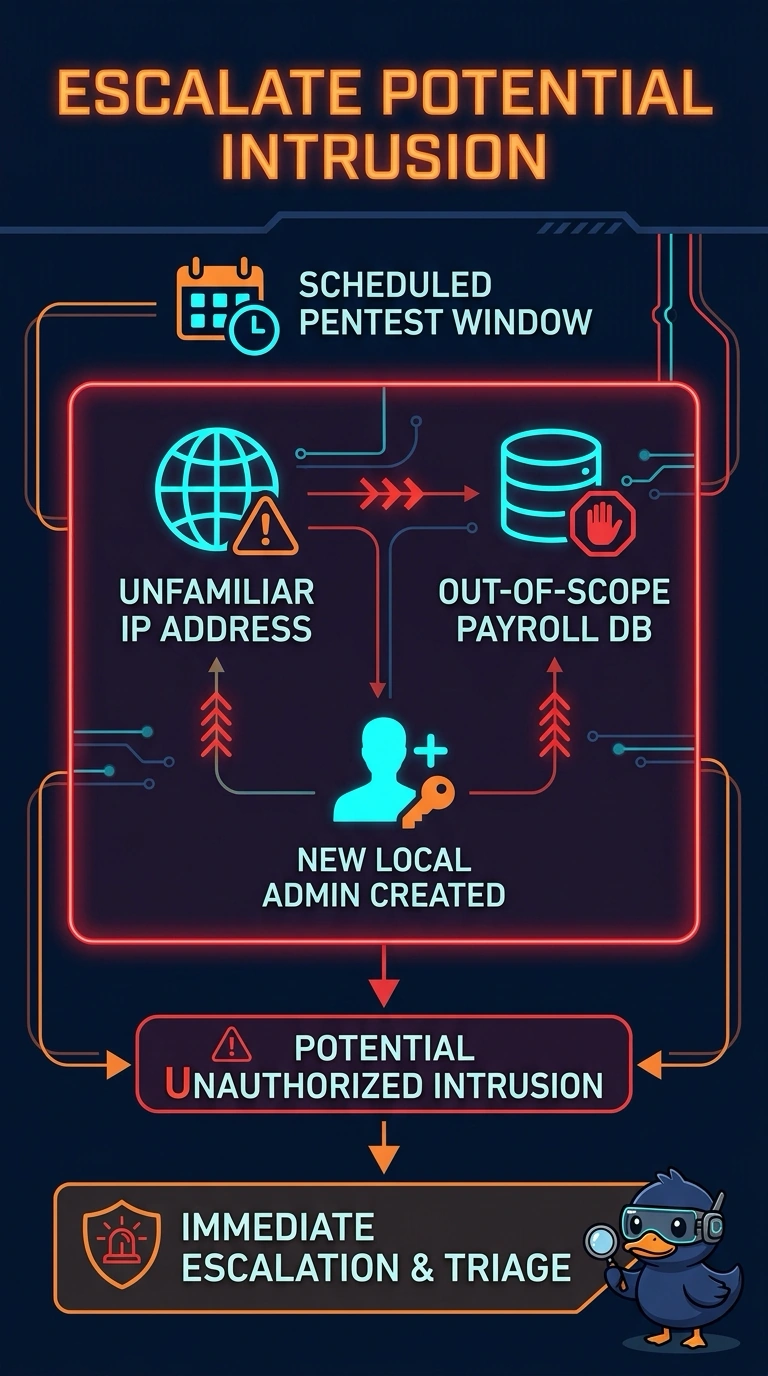
During a scheduled external penetration test window, a threat hunter spots credential-testing traffic from an unfamiliar IP address targeting an out-of-scope payroll database along with a newly created local administrator account. How should the analyst classify this activity?
Select an answer to reveal the explanation.
Short Explanation
An approved testing window is not a blank check for every IP address on the internet. When activity hits out-of-scope crown jewels and leaves unauthorized persistence, you must treat it as a real threat. The trap is letting a calendar entry lull you into ignoring clear signs of a live intrusion.
Full Explanation
Authorized assessments follow strict rules of engagement covering approved source IP addresses, target subnets, and permitted persistence rules, which makes Potential unauthorized intrusion requiring immediate escalation and triage the right classification. Activity originating from an unapproved IP address against an excluded payroll system, combined with unauthorized account creation, violates assessment boundaries and indicates a likely real-world attacker. Authorized assessment activity because it occurred within the approved window fails because timing alone never validates an intrusion; real adversaries frequently operate during business or testing windows. Routine vulnerability scanning that requires no escalation until tomorrow is wrong because Routine discovery scanning does not explain an unexpected administrator account; exploitation or assessment tools can create accounts, so verify scope and ownership while triaging the account creation. Benign administrative maintenance performed by the database owners is also unlikely when external unfamiliar IP addresses are probing credentials. As a caveat, penetration testers occasionally make configuration mistakes, so rapid out-of-band confirmation with the test lead helps verify ownership. As an operational check, contact the assessment coordinator out-of-band to confirm source IP ownership while simultaneously isolating the affected host and disabling the rogue account.