
During a threat intelligence review, a defender notes that blocking a custom credential-harvesting utility forced an intrusion group to pause operations for several days, yet the group later returned using a different utility to achieve the same goal. How does the Pyramid of Pain explain this outcome?
Select an answer to reveal the explanation.
Short Explanation
Taking away a burglar's favorite crowbar slows them down, but if you leave the back window unlocked, they will just buy a different pry bar. The trap is assuming that stopping one specific utility eliminates the behavior behind it.
Full Explanation
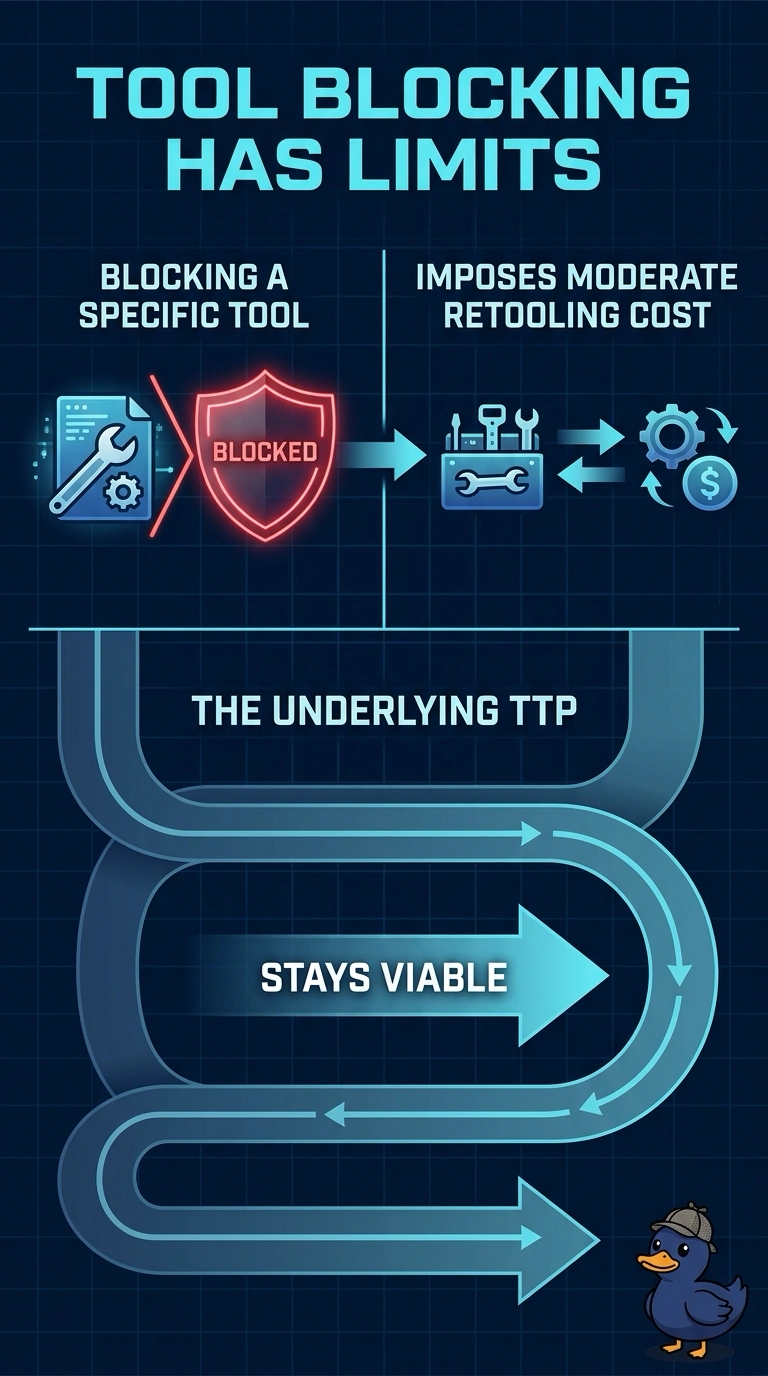
On the Pyramid of Pain, custom or specialized utilities sit in the Tools tier below TTPs, meaning Blocking a specific tool imposes moderate retooling cost, while the underlying TTP stays viable. Defenders force the adversary to spend time acquiring, compiling, or testing a replacement utility, but the attacker can still execute the same credential-access behavior using another program or native OS feature. Claiming that Blocking a tool sits at the top of the Pyramid of Pain and ends the campaign confuses Tools with TTPs, which occupy the highest tier and cause maximum disruption. Saying that Tools sit below IP addresses on the Pyramid of Pain and are trivial to swap inverts the hierarchy, since atomic indicators like IP addresses and hashes are far easier to rotate than software. Assuming that Tool detections automatically block every technique used for credential access overlooks how multiple distinct utilities can implement the same technique. As a caveat, tool-focused rules still deliver strong medium-term value when paired with behavioral detections. For an operational check, map each tool alert in your SIEM to its parent MITRE ATT&CK technique and verify you also have behavioral rules covering alternate utilities.