
While investigating two intrusions at different regional banks occurring in the same week, an analyst notices both incidents targeted financial institutions and attributes them to the same threat group. Why is this attribution conclusion premature?
Select an answer to reveal the explanation.
Short Explanation
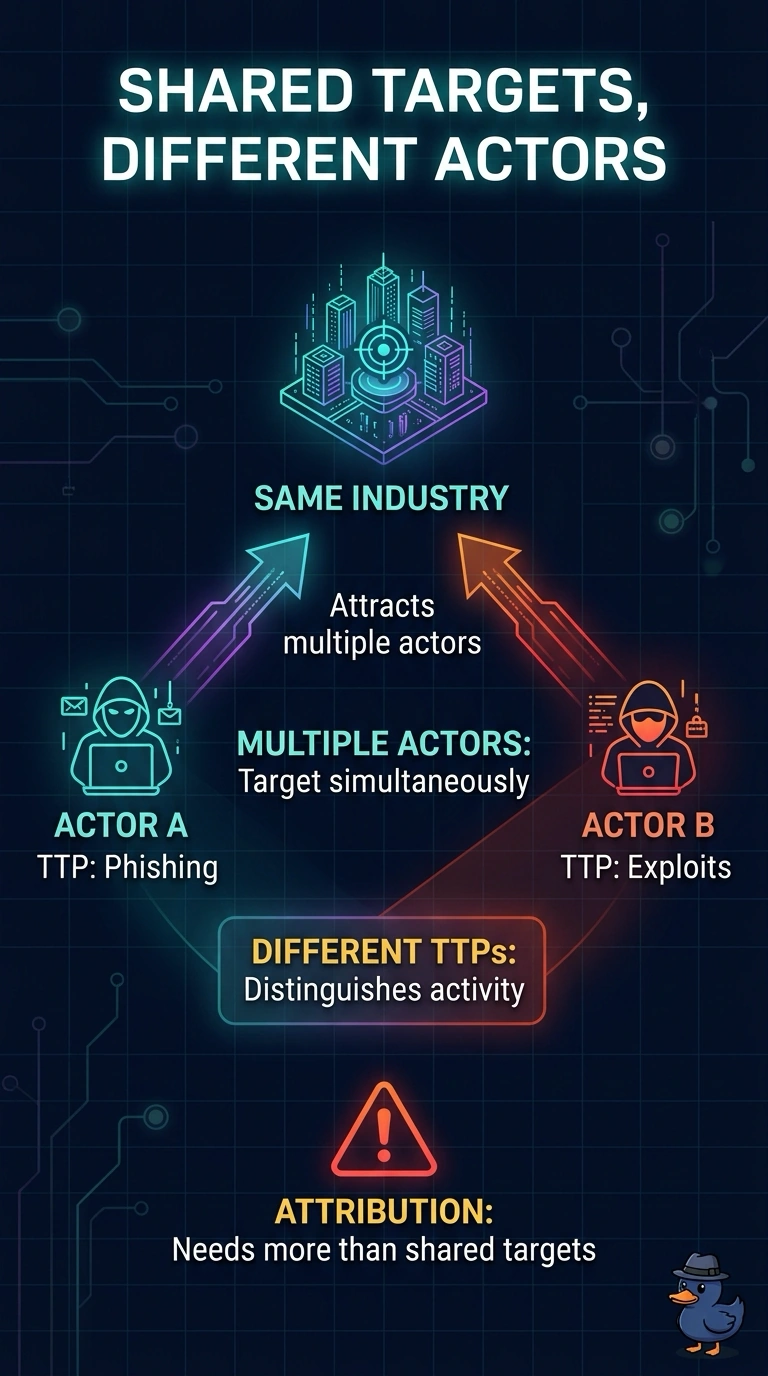
Two burglaries in the same neighborhood during the same week do not prove the same crew hit both houses. You need to compare how the intruders operated inside each network, because the classic attribution trap is mistaking shared victimology and timing for a single threat actor.
Full Explanation
Multiple distinct threat actors often target the same industry simultaneously using different TTPs, so victim sector and timing alone cannot establish shared attribution. High-value sectors like banking routinely attract independent financially motivated syndicates and state-aligned groups at the same time, especially when new vulnerabilities emerge. Concluding that Regional banks cannot share threat intelligence across competitors to verify intrusion timelines is false because sector sharing centers routinely coordinate anonymized timeline analysis. Similarly, Financial institutions typically deploy uniform security controls that prevent concurrent group activity is inaccurate, as security architectures vary widely and do not restrict which adversaries target them. Relying on the idea that Threat actor attribution requires matching exact employee usernames across both compromised networks is also flawed, because attackers target local accounts unique to each environment rather than reusing victim usernames. As an analytical caveat, victimology provides useful context only when paired with overlapping tooling, infrastructure, and post-exploitation behaviors. As an operational check, build a side-by-side matrix comparing initial access vectors, persistence methods, and command sequences across both incidents before assigning a cluster label.