
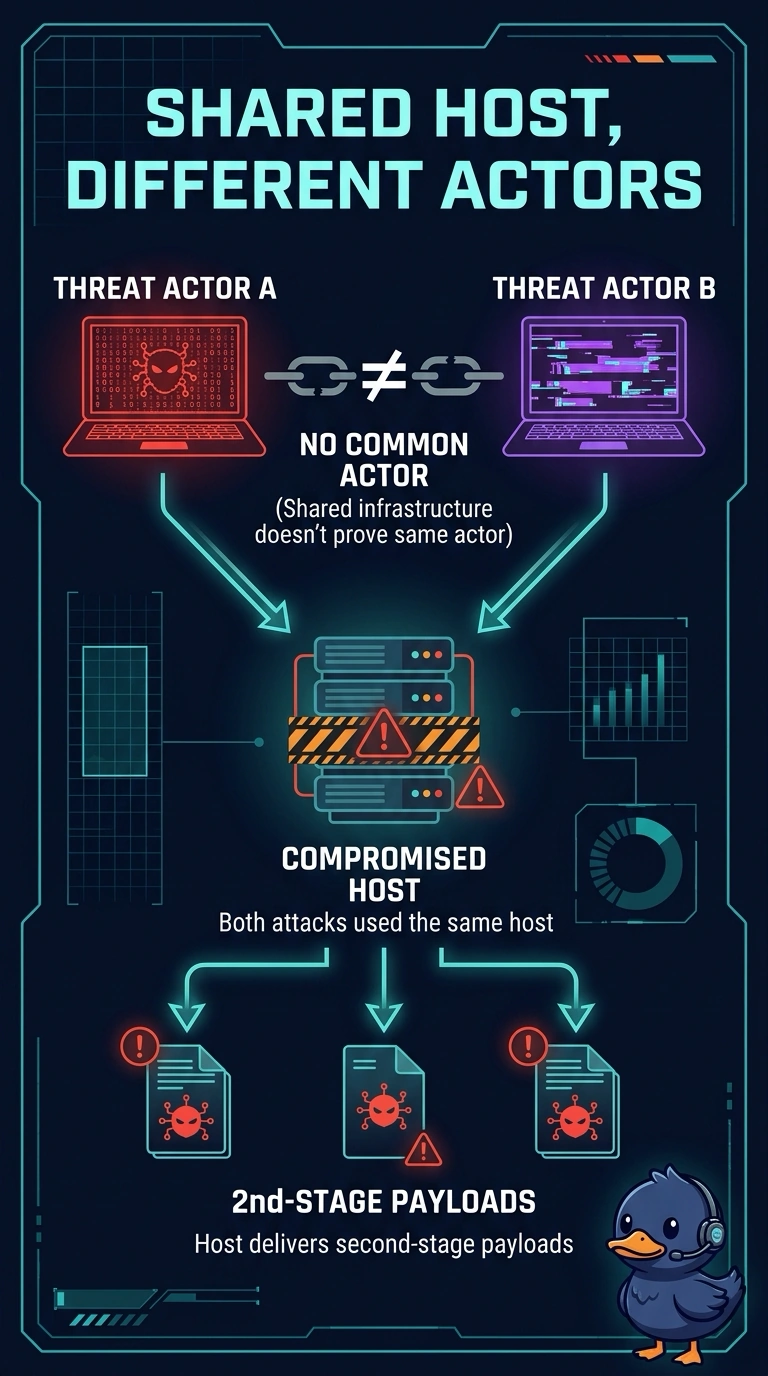
While investigating two separate intrusions at unrelated manufacturing firms, an analyst discovers that both attacks downloaded second-stage payloads from the same compromised small-business web server. Why should the analyst avoid attributing both intrusions to the same threat actor based on this finding?
Select an answer to reveal the explanation.
Short Explanation
Sharing a hijacked web server for malware staging is like two burglars using the same unlocked public alley—it tells you the spot was convenient, not that the same person broke in. The trap is treating a shared compromised host as an exclusive actor fingerprint instead of checking your behavioral evidence.
Full Explanation
Threat actors frequently compromise poorly patched, legitimate websites to host payloads and blend malicious traffic with ordinary web requests. Multiple threat actors often abuse the same compromised host for staging because opportunistic attackers and initial access brokers exploit the same public vulnerabilities or sell access to shared infrastructure. Attributing two incidents to one group solely from a shared staging server risks false linkage. Compromised third-party servers are never used by sophisticated threat actors is incorrect because advanced groups regularly hijack legitimate hosts to disguise command-and-control or delivery infrastructure. Second-stage payload URLs always belong to the victim's own internal infrastructure is false because adversaries routinely stage tools on external compromised sites or cloud services. Web server access logs automatically erase all external download records is wrong because standard web servers retain request logs unless explicitly cleared or rotated. As a caveat, shared staging infrastructure can still serve as weak supporting context when paired with overlapping tooling and post-exploitation TTPs. For an operational check, compare process-creation chains, credential-access methods, and command syntax across both incidents before clustering them under one actor.