
During a morning log review, a SOC analyst sees a single internal server rapidly probing hundreds of workstation ports over SMB and RDP. Which check best distinguishes an authorized internal vulnerability assessment from lateral movement?
Select an answer to reveal the explanation.
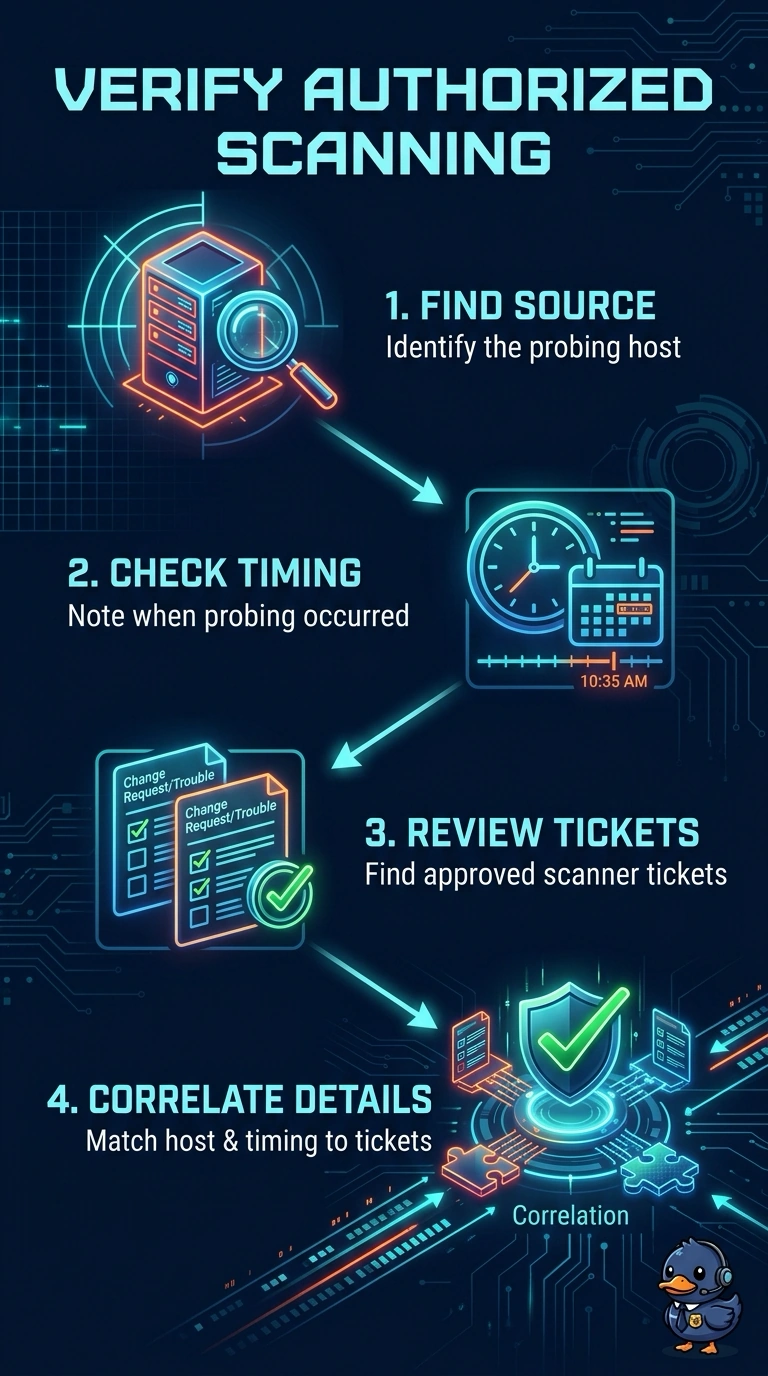
Short Explanation
A noisy port sweep looks identical to an attacker unless you check the calendar and guest list first. Your trap here is relying on technical traffic traits like credentials or encryption instead of verifying authorization records.
Full Explanation
Authorized vulnerability scanners and lateral-movement tools generate nearly identical network discovery patterns, so the reliable differentiator is administrative context. To confirm legitimacy, an analyst must correlate the source host and timing with approved scanner change tickets, verifying that the exact IP, target subnet, and execution window match a scheduled assessment. Verify whether the source IP address resolves to an external cloud provider fails because the scenario states the probe originates from an internal server, and external resolution does not prove authorization. Confirm that the scanning server uses standard administrative credentials is insufficient because attackers routinely abuse compromised administrative accounts during lateral movement. Check if the SMB traffic uses encrypted transport rather than cleartext also fails because both legitimate scanners and modern adversaries use encrypted SMB sessions. As a caveat, never dismiss an alert solely because a change window exists; confirm the target scope matches as well, since attackers sometimes time intrusions to coincide with maintenance. Operational check: cross-reference the scanning host asset tag against the vulnerability management team's active schedule and confirm out-of-band before closing the alert.