
During a review of two separate ransomware incidents using the same ransomware payload family, an analyst observes that the first intrusion used compromised VPN credentials and rapid automated deployment, while the second relied on phishing and days of manual network discovery. What does this behavioral divergence most likely indicate for attribution?
Select an answer to reveal the explanation.
Short Explanation
Just because two drivers rent the same model of delivery van does not mean they work for the same company, and you should apply that same logic to ransomware! The trap is attributing every incident with a matching payload family to one monolithic crew when your logs show completely different hands-on-keyboard habits.
Full Explanation
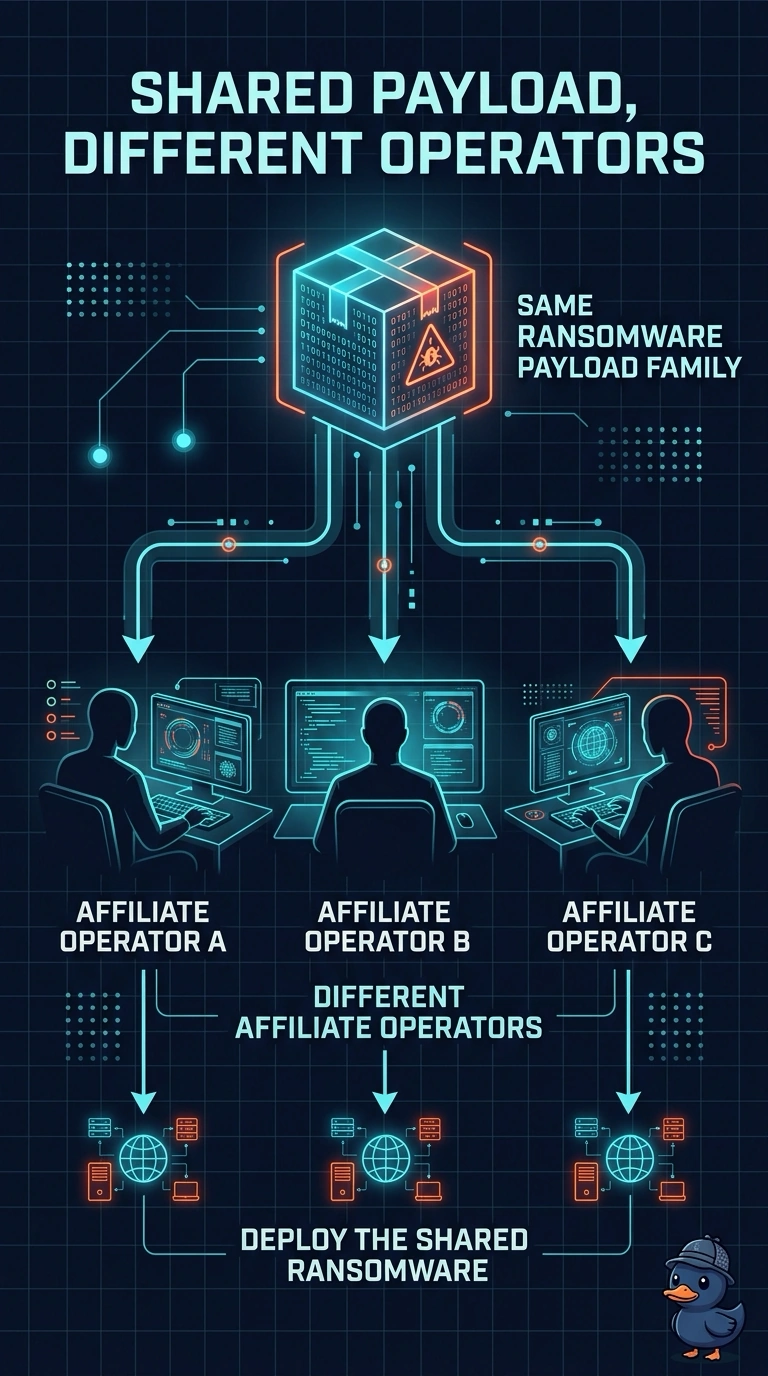
In modern Ransomware-as-a-Service ecosystems, core developers build and maintain the encryption binary while independent affiliates handle initial access, internal reconnaissance, and deployment. Concluding that Different affiliate operators deployed the shared ransomware explains why the same payload family appears alongside vastly different initial entry vectors, dwell times, and lateral movement tempos. Assuming The same developer group recompiled the binary ignores the sharp contrast in human-operated pre-deployment behaviors across the two intrusions. Claiming Both victims shared an identical firewall rule fails to account for why one intruder entered via stolen VPN credentials while the other used phishing and multi-day manual discovery. Believing The payload automatically altered its entry method confuses a post-exploitation encryption binary with an autonomous worm capable of choosing between phishing and credential abuse. Caveat: a single operator can occasionally switch tactics if an initial vector is blocked, so corroborate divergence across multiple post-compromise phases. Operational check: compare command-line syntax, staging directories, and lateral-movement tooling across both case timelines to cluster each operator separately.