
While reviewing host logs from an internal application server, a threat hunter notices an abrupt gap in security audit events immediately followed by unexpected service creation and remote administrative logons. What does this sequence most likely indicate about the actor's TTPs?
Select an answer to reveal the explanation.
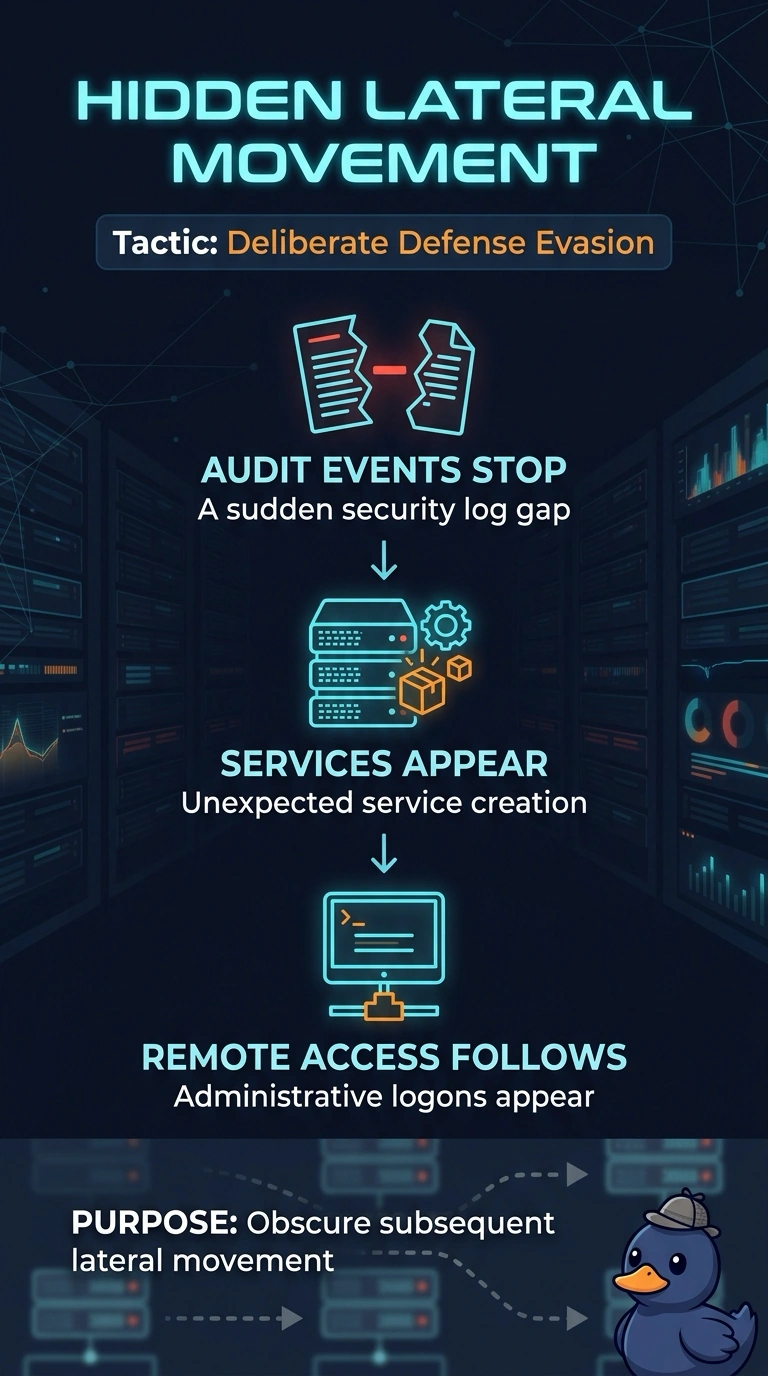
Short Explanation
When a security camera suddenly goes dark right before a vault opens, you are not looking at a coincidence. The trap is dismissing missing audit logs as a routine maintenance glitch instead of spotting an attacker covering their tracks.
Full Explanation
Deliberate defense evasion to obscure subsequent lateral movement best explains this pattern because adversaries frequently clear event logs or disable auditing right before executing persistence and remote movement steps. Correlating the sudden logging gap with immediate service creation and remote administrative logons points to intentional tampering rather than benign system behavior. Routine log rotation triggered by normal disk capacity thresholds fails because standard rotation archives older entries cleanly without coinciding with unexpected service creation and remote logons. Initial reconnaissance scanning performed from an external perimeter fails because external probing does not explain local audit-log gaps or internal service creation on an application server. Automated vulnerability scanning conducted by an authorized scanner fails because legitimate scanners do not disable host security auditing prior to executing checks. As a caveat, verify whether central log forwarding captured the audit-tampering event itself, since attackers often clear local logs after the action has already shipped to a SIEM. As an operational check, query your SIEM for log-cleared or auditing-disabled events and correlate them with any service creation or remote logon activity within the following minutes.