
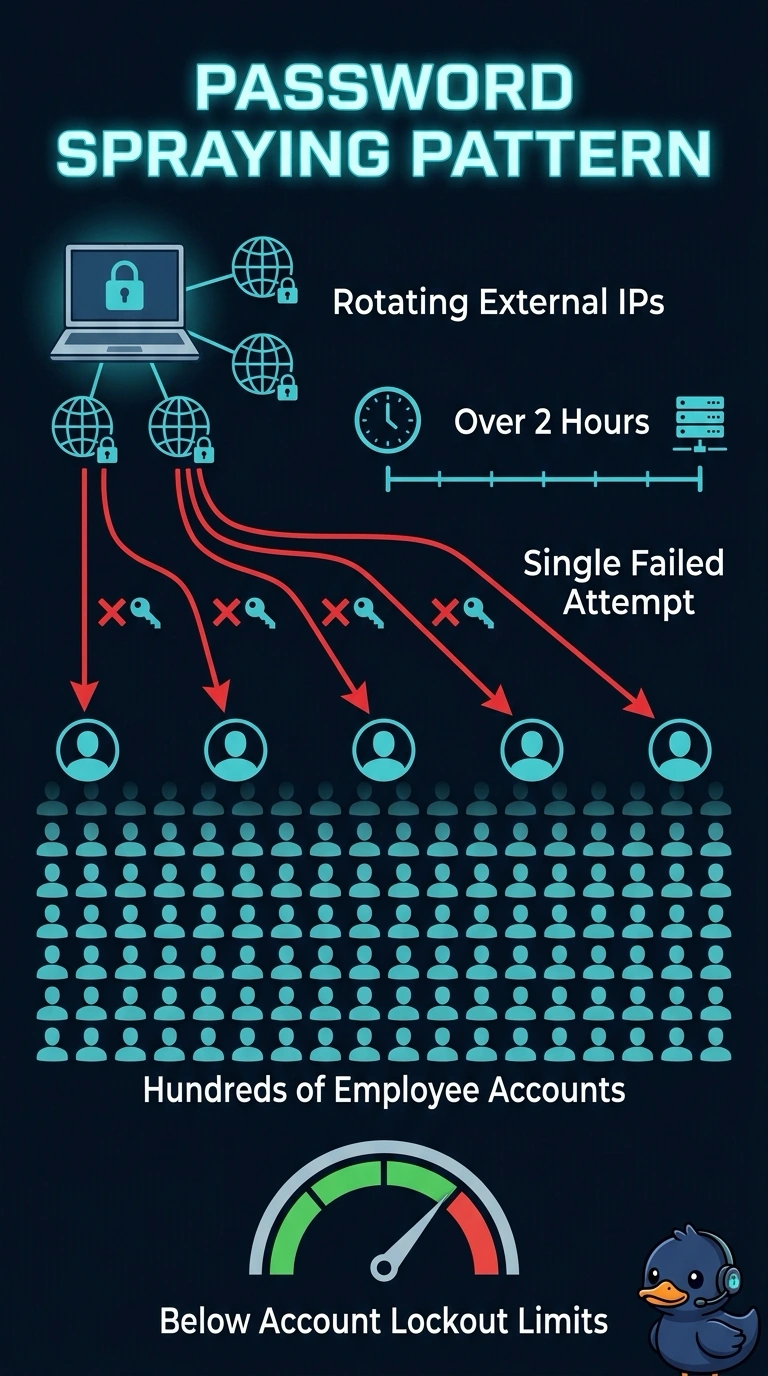
While reviewing cloud identity logs for a retail enterprise, an analyst notices single failed login attempts spread across hundreds of distinct employee accounts over two hours using rotating external addresses, with no single account locked out. Which adversary TTP does this log pattern most strongly indicate?
Select an answer to reveal the explanation.
Short Explanation
Testing one key on a hundred doors rarely trips the alarm that testing a hundred keys on one door will. You’re right to look beyond low per-account failure counts: this pattern fits password spraying designed to stay below lockout limits, though the failures alone do not prove password reuse across accounts.
Full Explanation
The horizontal pattern—single failed login attempts spread across hundreds of employee accounts—strongly indicates Password spraying designed to stay below account lockout limits. An attacker tries a small number of passwords across many accounts, keeping failures per account low; rotating external addresses can further disguise the activity when defenders track failures only by user or source IP. Single-account brute-force guessing against a local administrator is a poor fit because it concentrates repeated attempts on one account and can trigger its lockout counter. Automated vulnerability scanning targeting unpatched web services produces probes for web endpoints or software versions, not this pattern of cloud identity authentication failures. Internal lateral movement using harvested Kerberos service tickets occurs within an environment after access has been gained; it does not explain external failed logins spread across cloud employee accounts. Caveat: distributed spraying from residential proxies can blend into normal remote-work authentication noise if alerts count failures only per account. Practical check: aggregate identity logs by time window and user-agent string, then look for waves involving many distinct target usernames.