
An analyst compares two intrusion alerts in SIEM logs: one shows rapid, unauthenticated exploit attempts against hundreds of external-facing IPs using a fixed payload, while the other shows selective internal host discovery and interactive shell commands tailored to local directory names. What does this difference indicate?
Select an answer to reveal the explanation.
Short Explanation
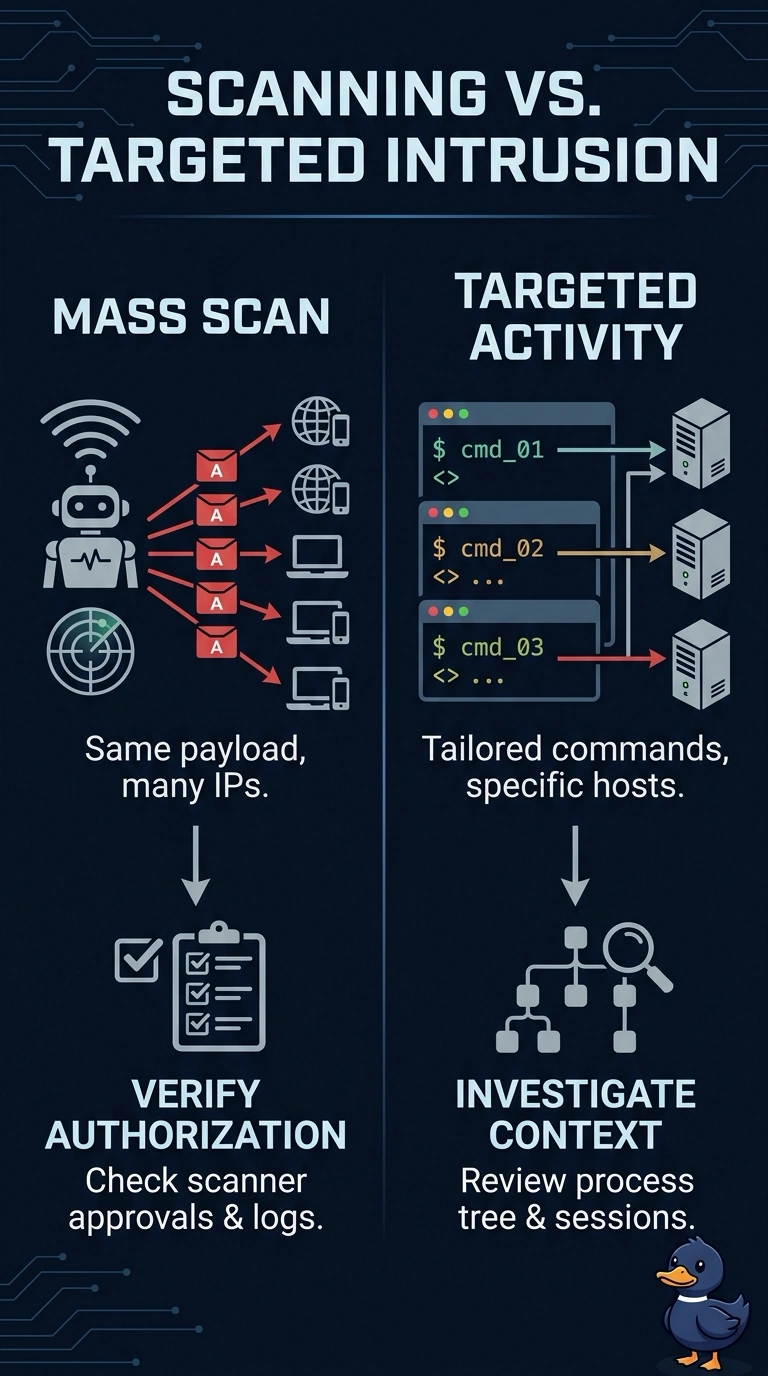
You can think of a fixed-payload sweep as trying the same key at every door, while selective internal discovery and tailored commands call for closer attention. In triage, targeting matters: noisy perimeter scanning can look dramatic, but quiet activity inside may warrant investigation of the operator and authorization context.
Full Explanation
Selective internal host discovery and interactive shell commands tailored to local directory names indicate targeted post-exploitation behavior, so you should investigate the operator and authorization context. The activity is focused rather than a broad, fixed-payload sweep. Tailored commands can come from a human, adaptive scripts, or AI-assisted automation; command content alone does not establish human control or rule out an advanced actor. Calling the rapid, unauthenticated attempts across hundreds of external-facing IPs patient reconnaissance by an advanced persistent threat misreads the scale and fixed payload, which are more consistent with indiscriminate scanning. Attributing both events to the same authorized internal vulnerability management scanner overlooks the unauthenticated external exploits and interactive internal commands, which do not match a single routine scanning profile. Treating the tailored commands as benign system maintenance simply because they use local directory names is also unsafe: adversaries may inspect naming conventions to blend in or locate valuable data. One caveat is that opportunistic automated scans can still lead to initial access when a host is unpatched, so perimeter hygiene remains important. As a practical check, inspect the parent process tree and authentication records to establish whether the activity was authorized.