
During an investigation at a media company, an analyst finds an open-source post-exploitation framework on a compromised web server and concludes the intrusion belongs to a single specific cybercrime syndicate. Why is this attribution conclusion unreliable?
Select an answer to reveal the explanation.
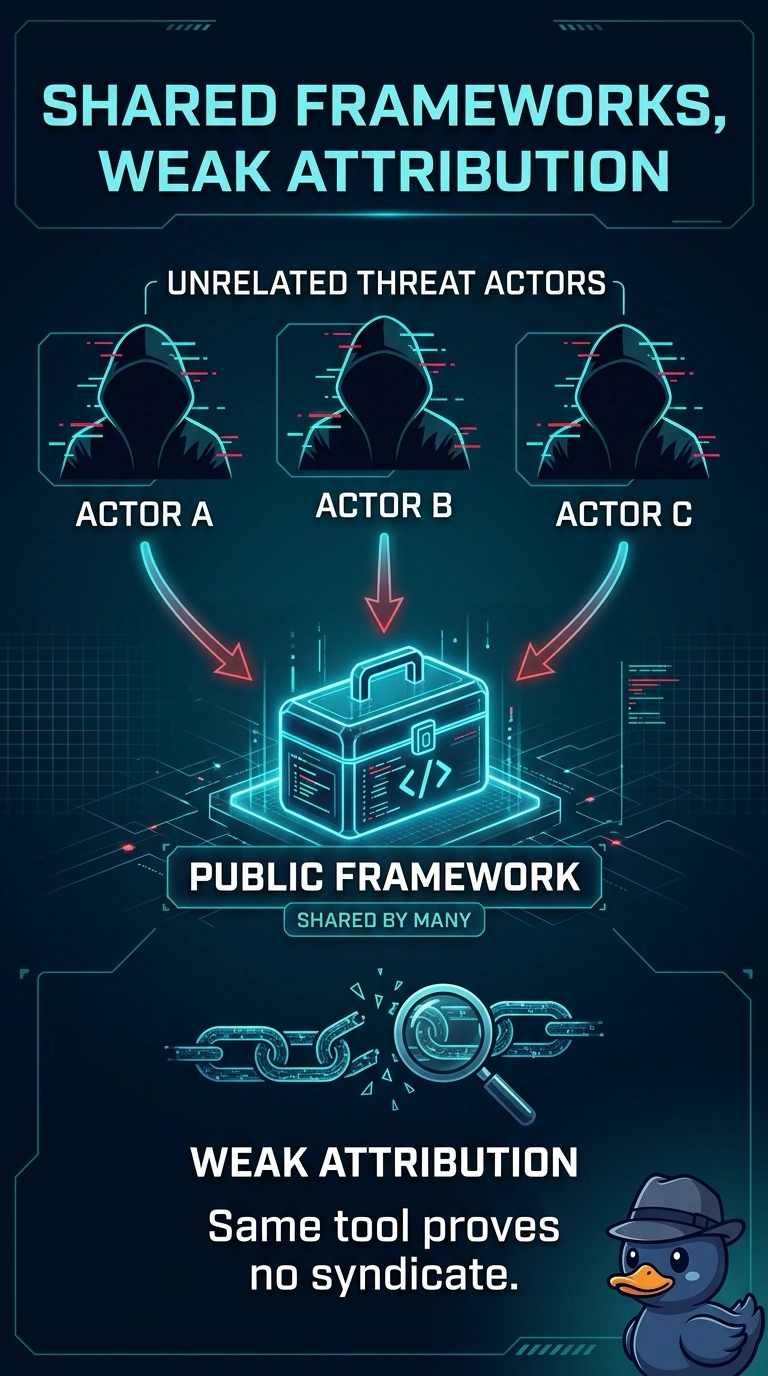
Short Explanation
Finding a popular open-source framework on a server is like spotting a common sedan at a crime scene: plenty of different drivers use the exact same model. Your trap is treating widely shared tooling as a unique fingerprint for one syndicate.
Full Explanation
Reliable threat actor attribution requires correlating unique behavioral patterns rather than pointing to commodity software. Because Multiple unrelated threat actors routinely share public frameworks, the mere presence of an open-source post-exploitation tool cannot isolate one syndicate from another, or even from an authorized red team. The idea that Open-source frameworks automatically erase all local authentication records is false, as log clearing requires explicit attacker actions or misconfigured retention rather than being an automatic property of public tools. Claiming that Public frameworks always sit at the highest tier of the Pyramid of Pain is also inaccurate, since tools sit below tactics, techniques, and procedures and can be swapped more easily than core tradecraft. Likewise, saying Authorized penetration testers are prohibited from using public tooling is wrong because assessors frequently rely on open-source frameworks under approved rules of engagement. As a caveat, custom modifications or unique configuration profiles inside a public framework can carry stronger analytical value. As an operational check, correlate post-exploitation command sequences and external infrastructure patterns across multiple logs before clustering activity.