
During a review of endpoint and proxy logs at a logistics provider, an analyst observes an intruder deploying a commercially available remote monitoring and management agent signed with a valid vendor certificate. Why does this artifact alone provide weak attribution confidence?
Select an answer to reveal the explanation.
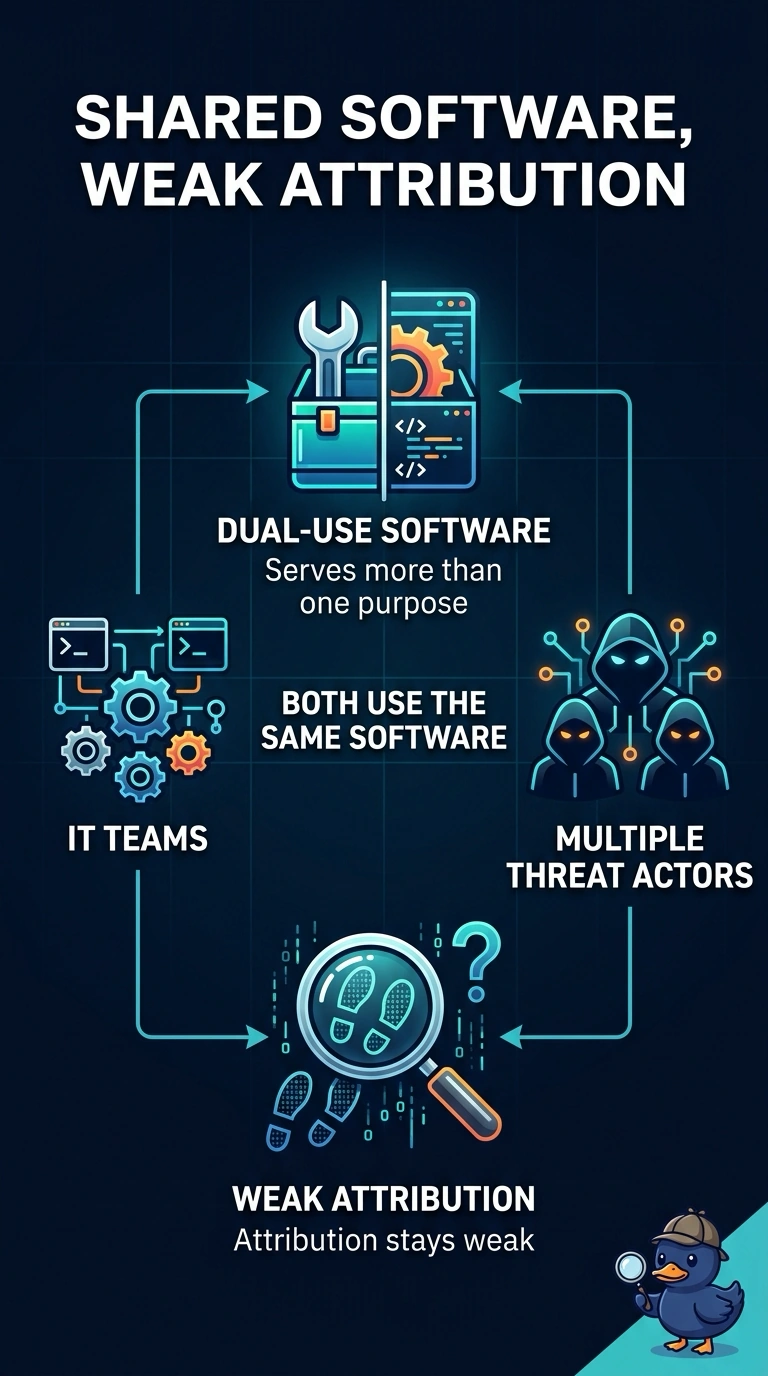
Short Explanation
Seeing a legitimately signed remote management tool in your logs can feel like finding a clear fingerprint, until you realize half the world owns the same shoes. The trap is assuming a valid signature proves benign intent or points to a single intruder. Because both administrators and diverse adversaries rely on dual-use software, you need broader behavioral context.
Full Explanation
Attribution requires distinguishing exclusive adversary tradecraft from tools shared across legitimate operations and unrelated campaigns, which is why Multiple threat actors and IT teams use the same dual-use software is the accurate explanation. Attackers frequently adopt commercial remote monitoring and management utilities to blend into normal administrative traffic and avoid writing custom backdoors. The claim that Valid code-signing certificates always confirm authorized internal IT deployment is false because adversaries routinely abuse legitimately signed third-party binaries or stolen certificates. Likewise, Commercial remote management agents sit at the top of the Pyramid of Pain is incorrect because specific tools sit below tactics, techniques, and procedures and are readily swapped. Finally, Network sensors cannot log traffic generated by signed administration tools is wrong because network telemetry still captures connection metadata regardless of binary signing. Caveat: dual-use tools can still support attribution when paired with unique configuration artifacts or infrastructure patterns. As an operational check, cross-reference the software installation against approved IT change tickets and baseline deployment records.