
While investigating a phishing campaign, an analyst finds that the attacker's domain WHOIS record lists a fictional company name and a privacy-shielded registrar. How should the analyst treat this registration data during attribution?
Select an answer to reveal the explanation.
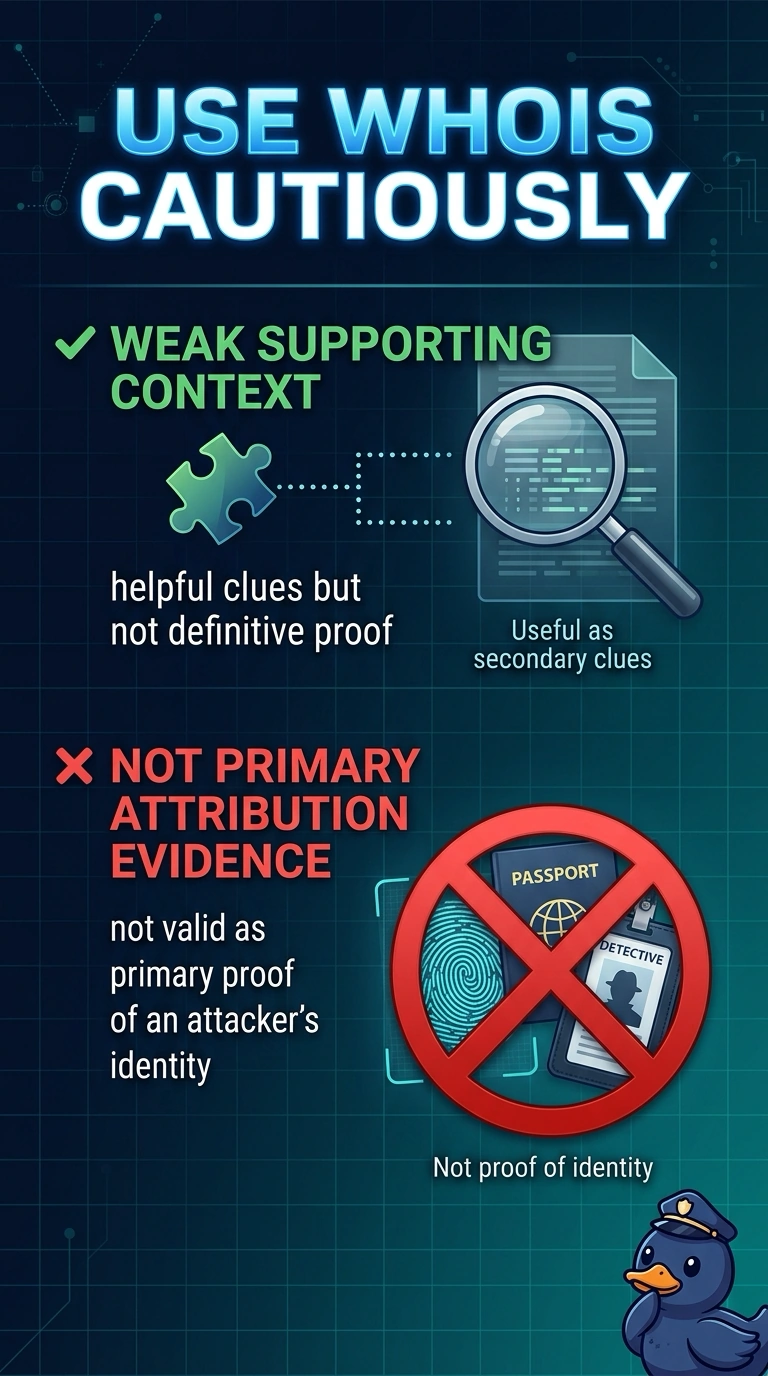
Short Explanation
Adversaries fill out domain registration forms the way pranksters sign guestbooks, so you should never treat a fictional name as a fingerprint. The trap is either over-trusting spoofed WHOIS fields or throwing away a useful hunting pivot altogether.
Full Explanation
Analysts should Treat it as weak supporting context rather than primary attribution evidence because Registrants must provide accurate contact data and registrars have applicable validation obligations, but public registration records can be redacted, proxied, stale, or falsified and do not by themselves identify an operator. A registrar-country field identifies the registrar’s jurisdiction, not the attacker’s location. Choosing to Attribute the intrusion to the geographic region shown in the registrar's country field falls for trivial spoofing or reflects only the hosting provider's jurisdiction rather than the operator's location. Similarly, deciding to Pivot solely on the registrant email address to assign a named threat actor risks misattribution when actors use disposable accounts or copy legitimate entities' contact details as false flags. Conversely, choosing to Discard the domain from all threat hunting queries because the WHOIS data is fake wastes a concrete operational observable that can still reveal targeted internal users in proxy and DNS logs. A key caveat is that while WHOIS metadata cannot identify a threat actor alone, subtle reuse patterns in hosting infrastructure or certificate fields can still support clustering when paired with behavioral TTPs. For an operational check, query passive DNS and internal proxy logs for the domain while correlating any visited endpoints against post-exploitation process telemetry.