
While reviewing endpoint and proxy logs from a two-week intrusion, an analyst observes a commodity phishing loader deployed on day one, followed four days later by interactive domain enumeration and hands-on-keyboard lateral movement using different infrastructure. What does this pattern most likely indicate for attribution?
Select an answer to reveal the explanation.
Short Explanation
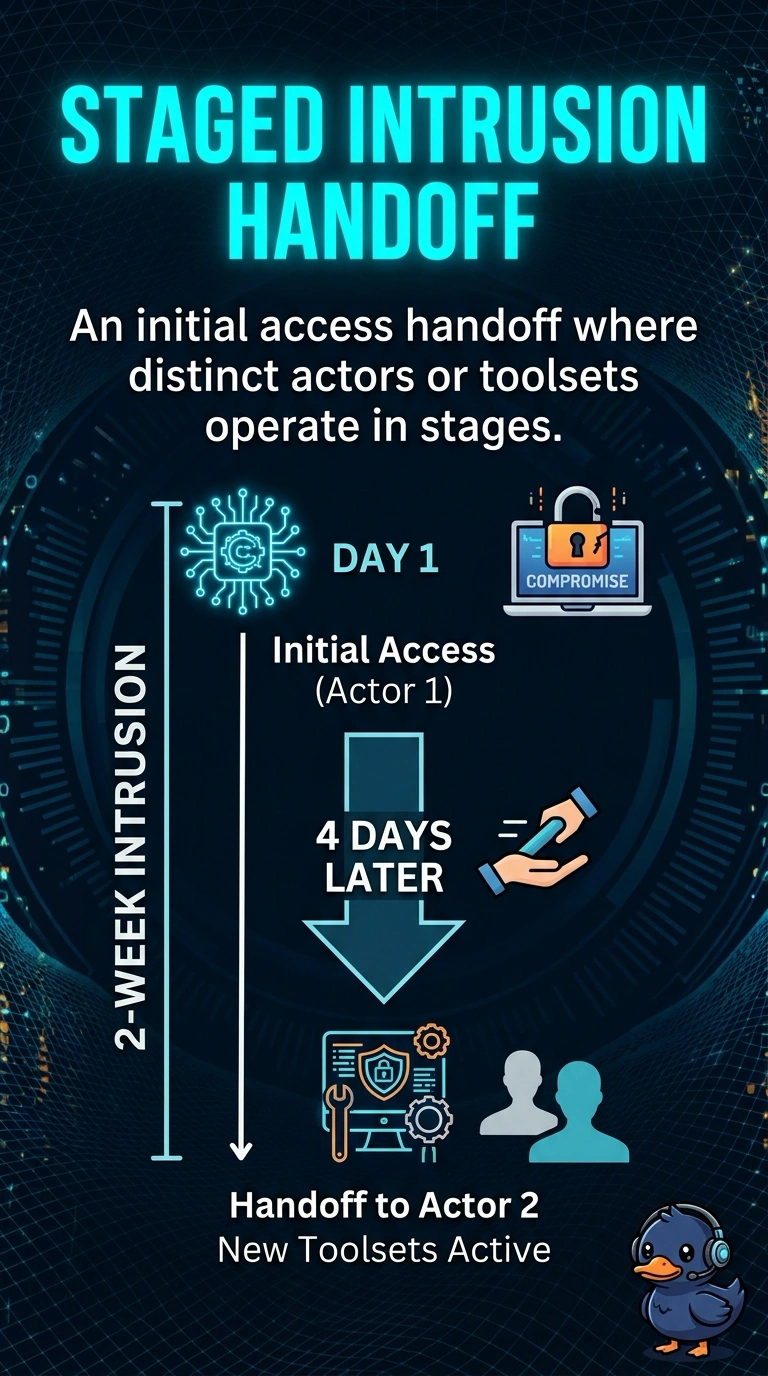
You can think of this as a handoff: the crew that establishes access may not be the crew that operates inside the network days later. If you attribute the whole intrusion from the day-one loader alone, you may miss the shift in actors or toolsets.
Full Explanation
An initial access handoff involving distinct actors or toolsets operating in stages is the best fit: initial access brokers may use commodity phishing loaders to establish a foothold, then transfer or sell access to operators who bring different infrastructure and conduct interactive post-exploitation activity. A single automated worm replicating randomly without human operator involvement does not fit the delay followed by interactive domain enumeration and hands-on-keyboard lateral movement; random propagation would not explain that change in behavior. An authorized vulnerability scanner performing routine weekly compliance checks does not account for a phishing loader or interactive lateral movement. A harmless software update misfiring across unrelated corporate workstation subnets likewise does not explain the distinct infrastructure or domain enumeration. As an exam caveat, one sophisticated group could compartmentalize its own first-stage and second-stage toolsets, so a behavioral shift alone does not prove a change in ownership. As a practical check, group timeline artifacts by host, account, and external infrastructure, then verify whether post-exploitation sessions originated from the initial loader’s persistence mechanism.