
During an intrusion investigation, a threat hunter extracts a custom HTTP User-Agent string and a specific registry run-key path used by the malware. How are these observables classified on the Pyramid of Pain?
Select an answer to reveal the explanation.
Short Explanation
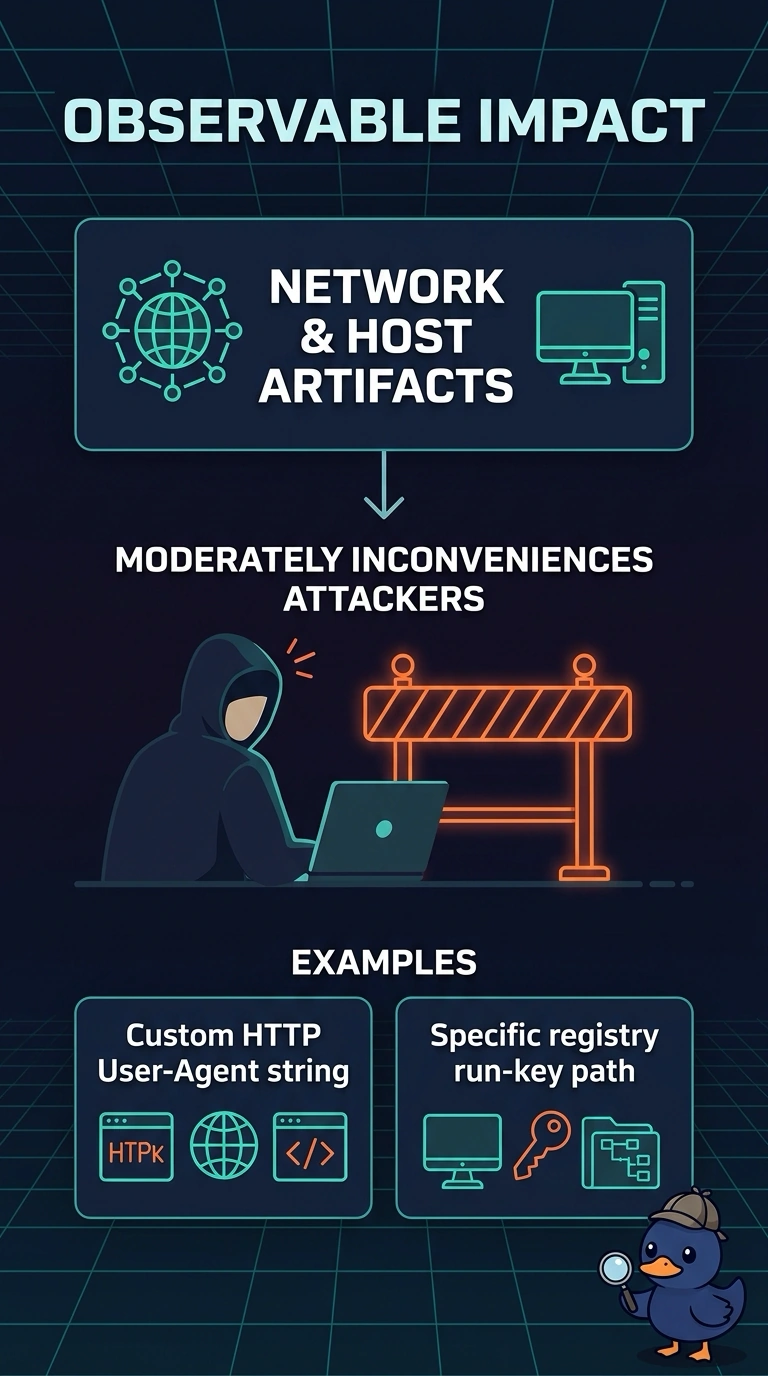
You can place custom HTTP User-Agent strings and specific registry run-key paths among mid-tier network and host artifacts in the Pyramid of Pain. Detecting them makes an attacker change malware configuration or parts of their setup, but they are not the high-level behaviors at the top.
Full Explanation
Custom HTTP User-Agent strings and specific registry run-key paths are network and host artifacts that moderately inconvenience attackers, placing them in the middle tier of the Pyramid of Pain. Detecting these observables creates friction because an adversary may need to change how malware communicates or persists, though that is easier than abandoning entire tools or behaviors. Tactics, techniques, and procedures are overarching adversary methods and behavioral patterns at the highest disruption tier, not individual strings or registry paths. File hash values are at the bottom of the pyramid because changing a single byte can produce a different hash, making this indicator easy to evade. IP addresses that attackers rotate effortlessly across cloud hosts belong to a lower tier than host and network artifacts. One caveat is that attackers may mimic legitimate browser User-Agent strings or use common registry locations to blend in, so broad rules can create false positives. As a practical check, pair artifact-based detections with parent-process context to confirm malicious execution.