
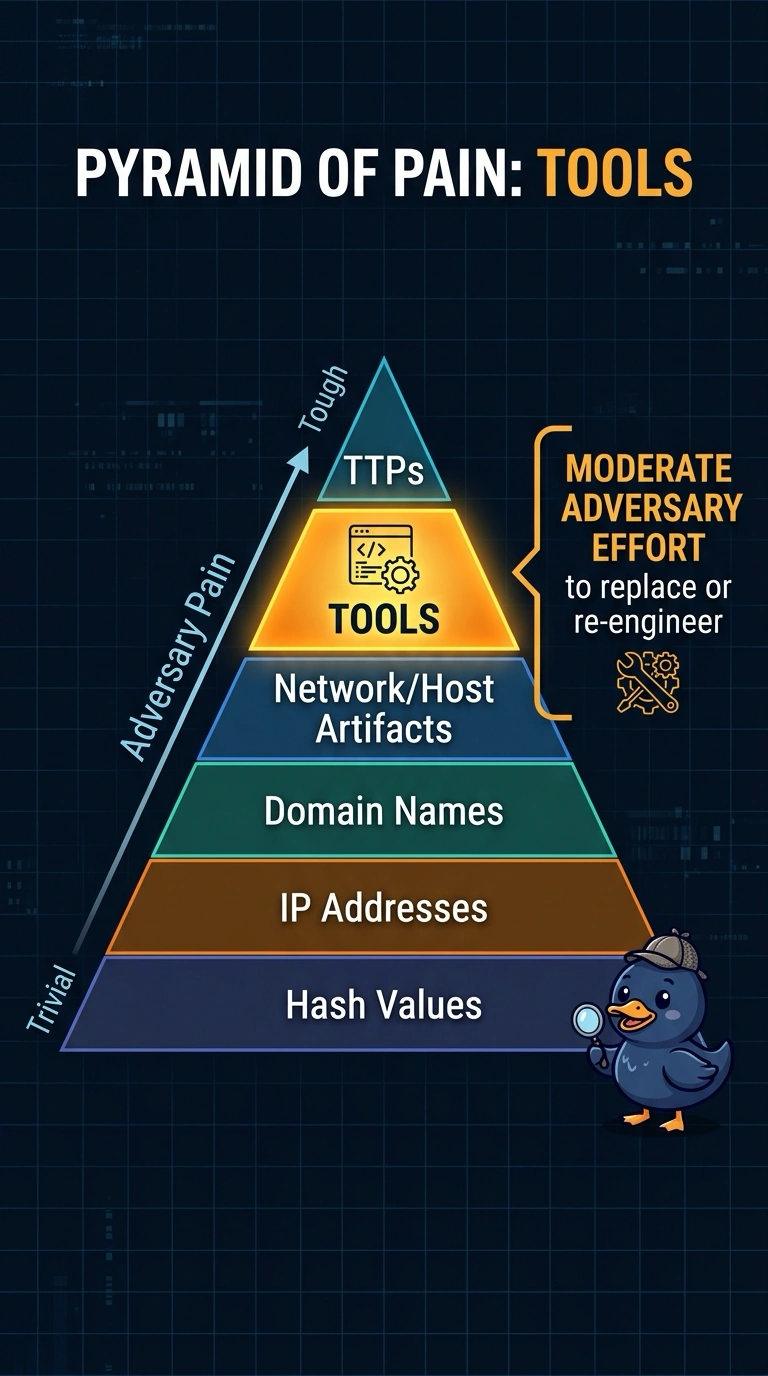
During a containment review at a logistics enterprise, defenders deploy detections targeting a specific custom credential-harvesting utility, forcing the intruder to abandon the tool and compile a replacement before resuming operations. Where does this observable sit on the Pyramid of Pain?
Select an answer to reveal the explanation.
Short Explanation
When you disrupt a custom credential-harvesting tool, the intruder must build, acquire, or re-engineer a replacement before resuming operations. You can distinguish that effort from rotating network artifacts or domain names; changing tactics, techniques, and procedures means changing the adversary’s broader behavior.
Full Explanation
Tools, which require moderate adversary effort to replace or re-engineer, is correct because custom or specialized malware utilities sit in the upper-middle tier of the Pyramid of Pain: disrupting the software can force the actor to write, acquire, or recompile a new capability. Network artifacts, which are routinely rotated without modifying core tooling, is incorrect because observables such as user-agent strings or URI paths sit lower on the pyramid and can be changed in configuration files without rebuilding the utility. Domain names, which adversaries register in bulk for rapid infrastructure swaps, is incorrect because domains also sit lower on the pyramid and are far cheaper to replace than custom software. Tactics, techniques, and procedures, which represent the hardest behaviors to change, is incorrect because TTPs sit at the peak and describe how an adversary operates regardless of which specific utility they use. As an exam caveat, blocking a tool by a single file hash only hits the bottom tier, so defenders must target structural tool traits to impose real cost. For a practical check, track whether post-containment intrusion attempts return with identical behavioral objectives under newly compiled binaries.