
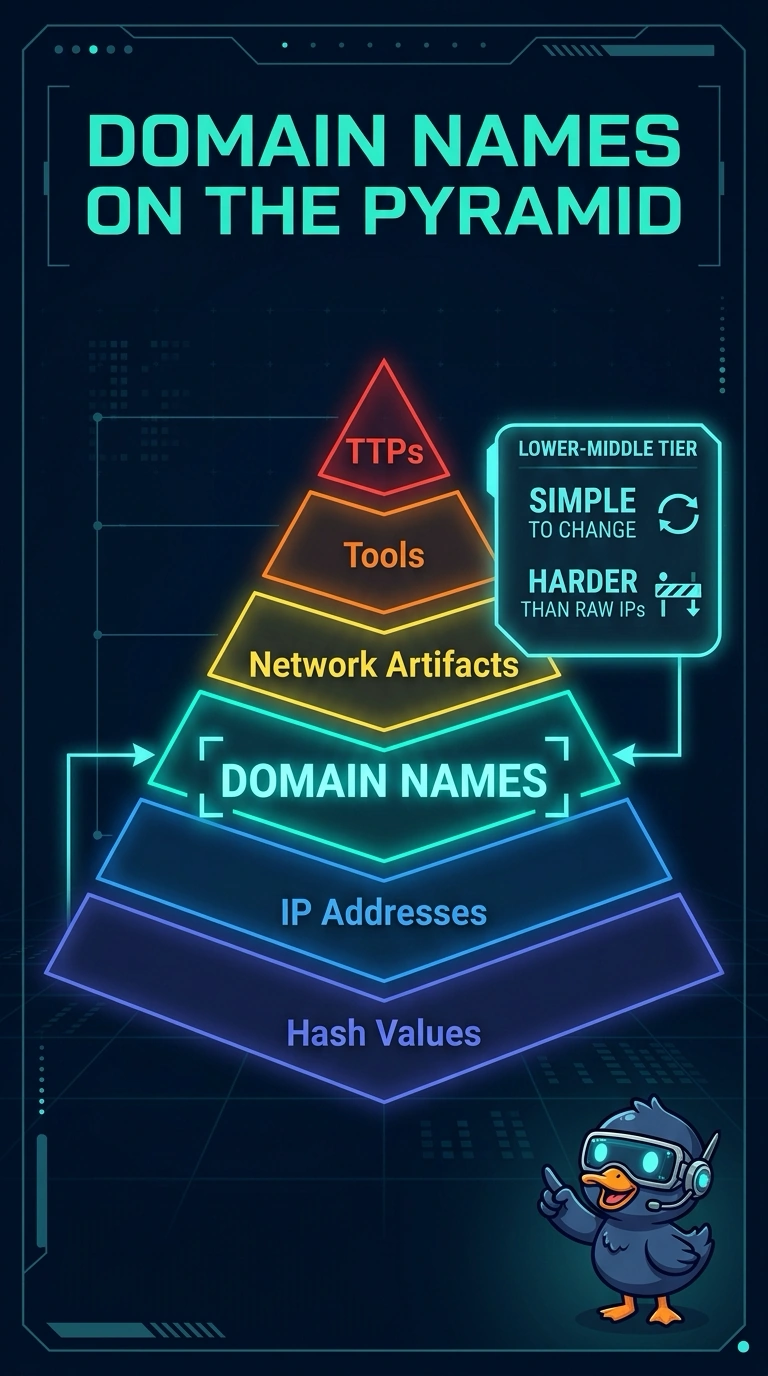
During an attribution and disruption review, a defender notes that blocking newly registered command-and-control domains slows an adversary down more than blocking IP addresses, yet the actor still recovers. Where do domain names sit on the Pyramid of Pain?
Select an answer to reveal the explanation.
Short Explanation
Blocking a domain name makes an attacker do a bit more paperwork than swapping an IP address, but it still will not stop your adversary for long. The trap you want to avoid is mistaking domain rotation friction for the deep pain of disrupting tactics.
Full Explanation
Selecting "In the lower-middle tier, simple to change though harder than raw IPs" is accurate because domain names sit just above IP addresses and file hashes on the Pyramid of Pain; registering and configuring new domains takes slightly more time and money than rotating an IP, yet adversaries can still automate domain changes quickly. Conversely, "At the very top, representing behavioral tactics that are hardest to alter" misidentifies domain names as tactics, techniques, and procedures, which require attackers to completely reinvent their workflows. Similarly, "At the very bottom, where changes require zero adversary effort or cost" describes file hashes, which change with a single byte modification. Finally, "In the upper-most tier alongside custom adversary tooling and exploits" exaggerates the difficulty of replacing a domain name compared to rewriting malware or rebuilding exploits. As a caveat, disrupting domains can still buy responders valuable containment time during an active incident, especially when paired with DNS sinkholing. For an operational check, track how quickly a tracked actor rotates domains after a block and escalate detection efforts toward behavioral host and network patterns.