
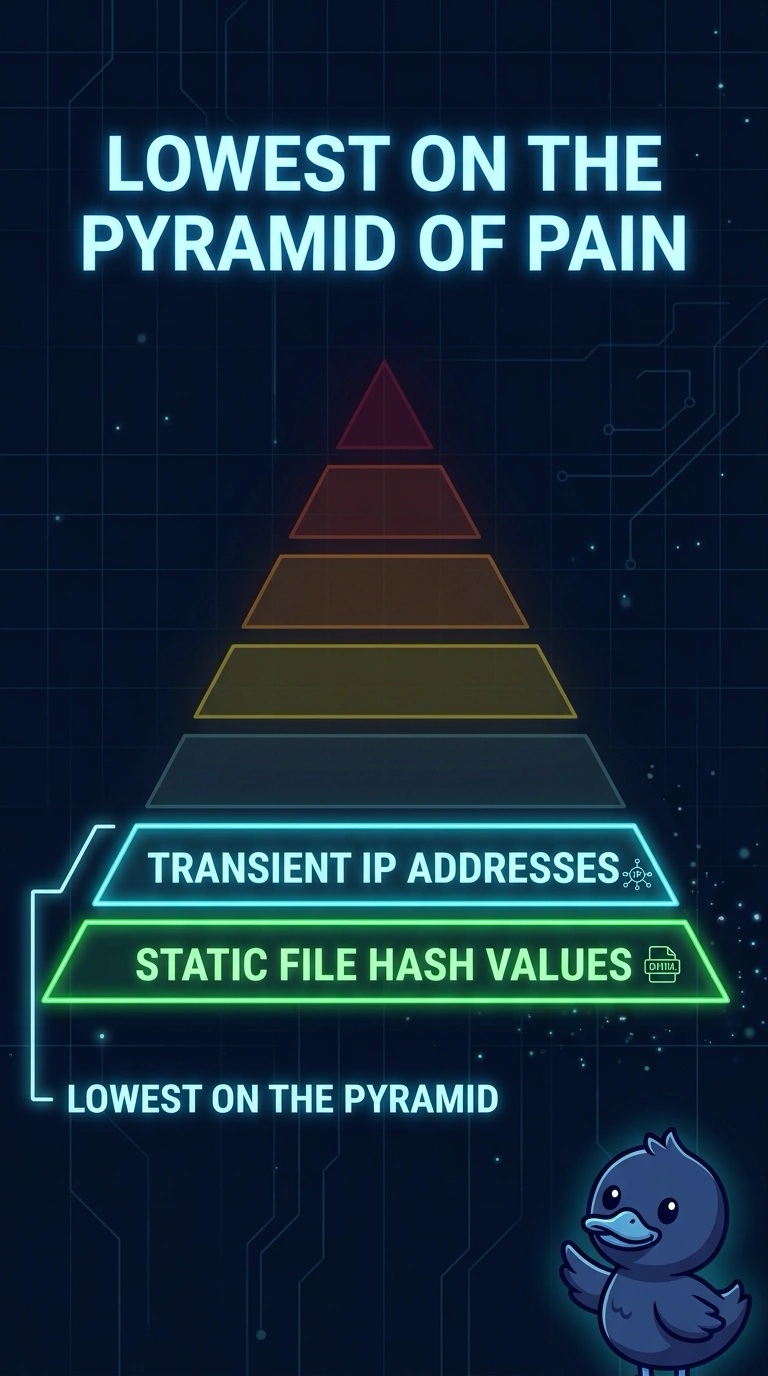
A defense team wants to understand why blocking indicators from daily threat feeds rarely disrupts a determined adversary for long. Which pair of artifacts sits lowest on the Pyramid of Pain and is easiest for an attacker to change?
Select an answer to reveal the explanation.
Short Explanation
Blocking a single hash or IP feels productive, yet to a skilled attacker it is about as inconvenient as changing lanes on an empty highway. When you rely on those atomic indicators at the bottom of the Pyramid of Pain, adversaries simply recompile or rotate addresses while keeping their core tools and behaviors intact. Don't fall into the trap of mistaking easy-to-block indicators for high-impact disruption.
Full Explanation
Static file hash values and transient IP addresses is correct because hash values and IP addresses occupy the lowest tiers of the Pyramid of Pain; an adversary can recompile a payload or spin up a new cloud relay in minutes to bypass defenses built solely on these indicators. Custom adversary command-and-control tools sit higher on the pyramid because replacing or rewriting bespoke software requires significant development time and testing. Multi-stage lateral movement methodologies represent tactics, techniques, and procedures at the top of the pyramid, forcing an attacker to completely redesign how they operate. Persistent credential harvesting behaviors also reflect higher-level TTPs that are far harder for an intrusion team to abandon than a disposable address or file hash. As a caveat, low-level indicators are still useful for rapid, short-term blocking and historical scoping, even though they do not provide durable long-term defense. As an operational check, audit your active SIEM detection rules and calculate the ratio of behavioral detections to static hash or IP-only rules to ensure your coverage is not top-heavy on brittle indicators.