
Cisco Secure Network Analytics can match flows to known-bad addresses and can also flag a host that behaves unlike itself. Which of those findings is not a feed match?
Select an answer to reveal the explanation.
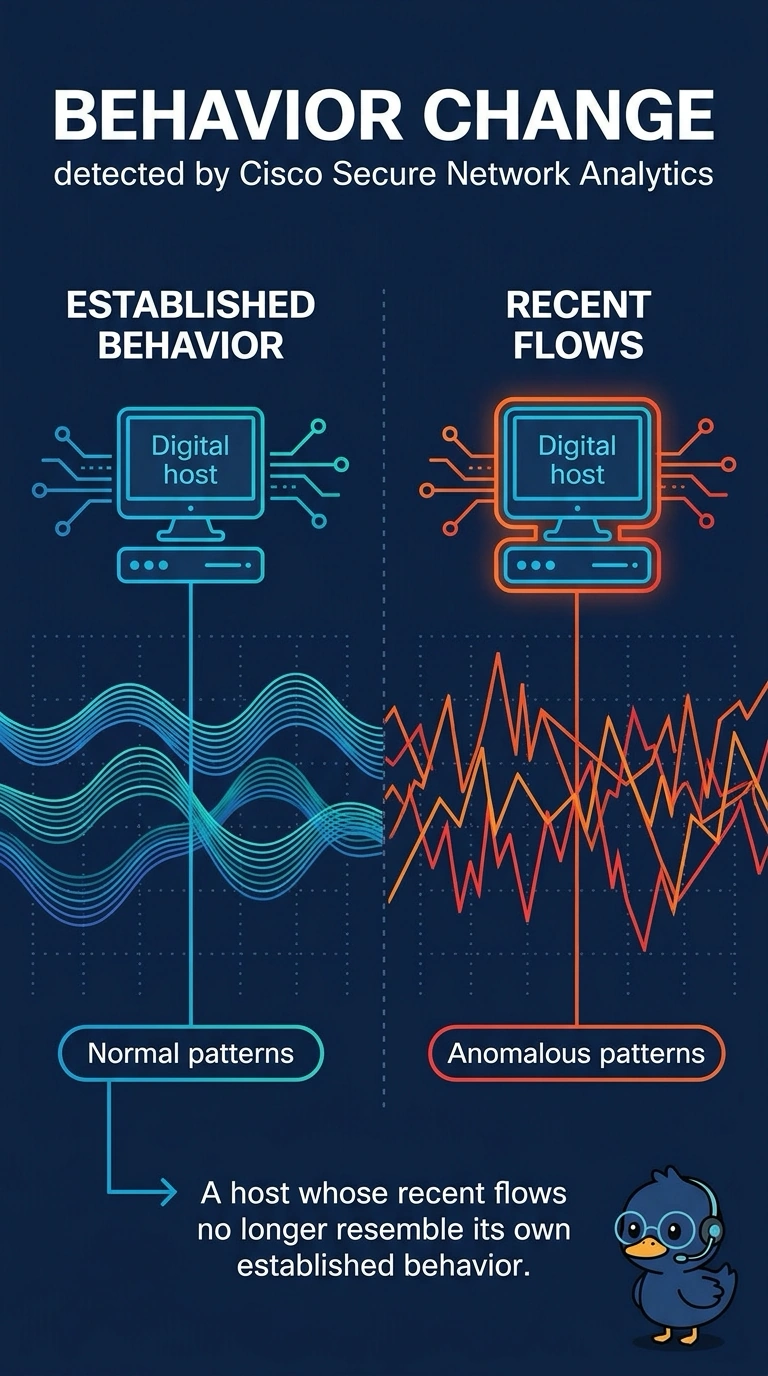
Short Explanation
A friend acting unlike their usual self is not the same as a name on a wanted poster, and you can tell the two apart. The finding that is not a feed match is the host whose recent behavior no longer resembles its own past. Hits against a known-bad list, a reputation feed, or a threat-intelligence address are the feed matches.
Full Explanation
A feed match is a hit against intelligence someone supplied, such as a known-bad address. The finding that is not a feed match is a host whose recent flows no longer resemble its own established behavior; that comes from a baseline of the host, not from an imported list. A host that sent flows to an address present on a known-bad intelligence list is a feed match. A remote address that matches an entry in an imported reputation feed is a feed match. A peer address the deployment links to a threat-intelligence indicator list is a feed match as well. Secure Network Analytics can raise both kinds of findings on one host, so read which kind this event is before you pick a response. A list hit supports a block more directly than a behavior shift, which may be a new business process. Exam caveat: behavior that looks new can still be legitimate change, so a baseline alert is a lead to investigate rather than an automatic block by itself. Operational check: open the Secure Network Analytics event and see whether the text cites the host historical behavior or names an intelligence list, a reputation feed, or an indicator.