
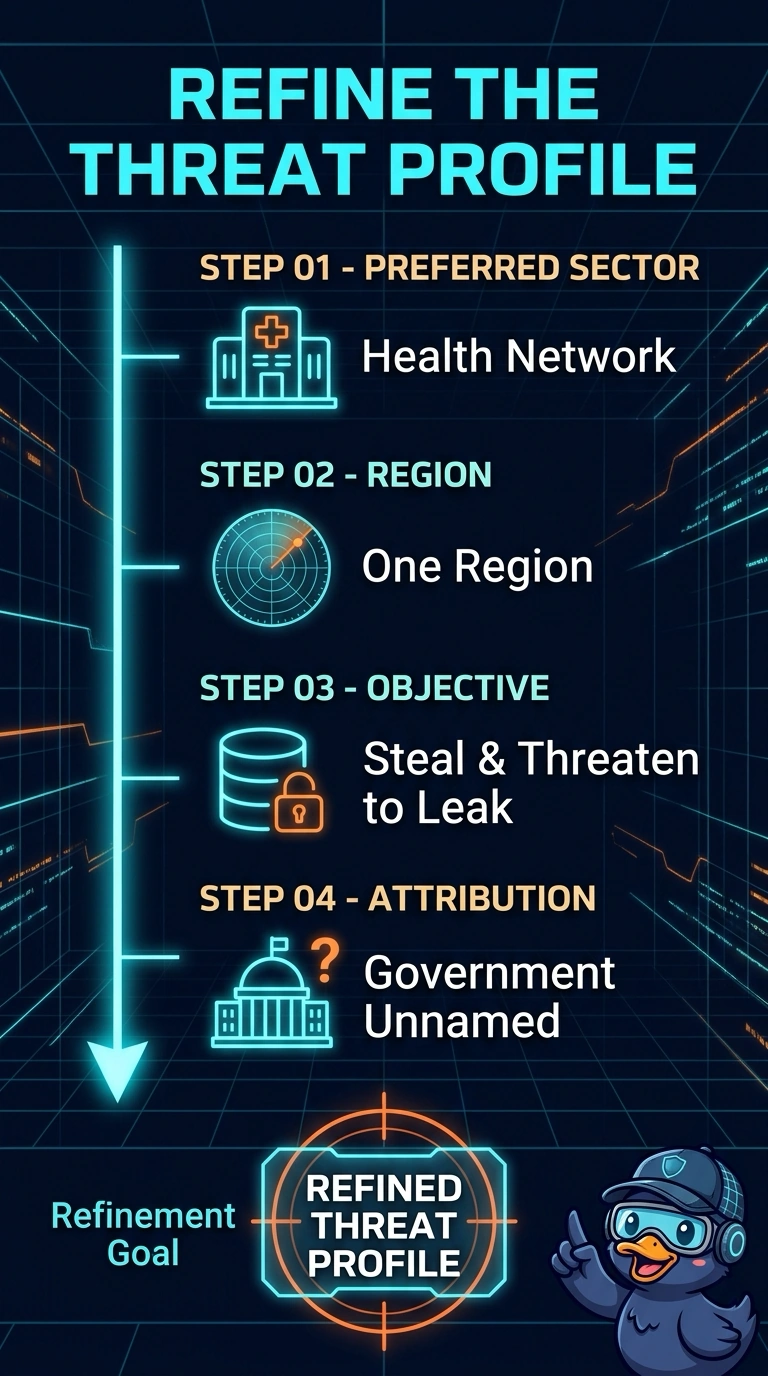
Intrusions against a health network hit only hospitals in one region, steal data, and then threaten to leak it. How does victimology help the threat-actor profile?
Select an answer to reveal the explanation.
Short Explanation
Who a burglar keeps visiting, and what they demand on the way out, tells you about their habits. You use victimology here to record hospitals in one region and a theft-then-leak objective. The trap is treating that pattern as proof that a named government ordered the incidents.
Full Explanation
Victimology is the picture of who was hit and what the attacker seemed to want. Here it records the preferred sector, the region, and the theft-then-leak objective, tightening the profile while leaving any government unnamed. Hospitals in one region, followed by theft and a leak threat, describe targeting and intent. That is useful profile material, and it is not the same as naming a sponsor. It does not prove that a named government ministry ordered the hospital incidents across this affected region. A sector focus can fit many kinds of crews. It does not remove any need to record the techniques, the infrastructure, or an explicit confidence statement. Those fields answer different questions, and victimology does not replace them. It does not add nothing once two of the samples are shown to share one code-signing certificate fingerprint. A shared certificate is an infrastructure clue, and the victim pattern is a separate clue. Exam caveat: victimology supports targeting and objective, and a copycat can imitate a sector, so the profile should keep confidence explicit. Operational check: write sector, region, and the theft-then-leak sequence into the profile, and leave the sponsor field blank until stronger evidence exists.