
Separate intrusions at a branch office use the same techniques and the same tool marks, and they also share one IP address. Why do the techniques and tool marks outweigh that shared address?
Select an answer to reveal the explanation.
Short Explanation
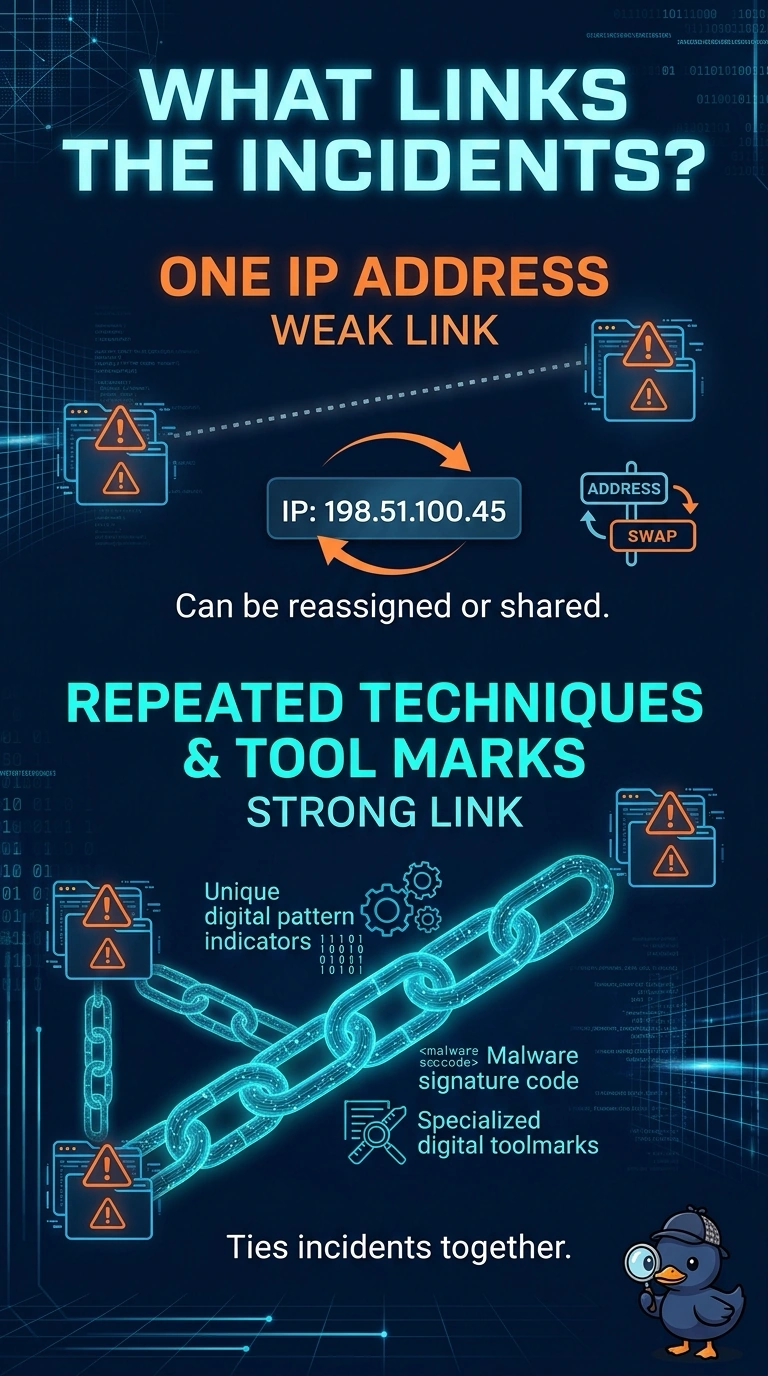
A repeated way of picking the lock says more than one street address any neighbor might share. You give more weight to techniques and tool marks that recur across the incidents than to a single address. The trap is treating that address as sponsor proof while ignoring how easily an address gets reused.
Full Explanation
Infrastructure such as an IP address is easy to reuse, reassign, or place on shared hosting. Behavior is stickier. Repeated techniques and tool marks tie the incidents more strongly than one address that can be reassigned or shared, especially when the same marks show up in intrusions that are separated in time. A single shared address is not enough sponsor proof, and it is not true that the techniques change too often to compare in a useful way; the techniques are the stable clue in this set. Matching tool marks do not matter only if these incidents also share one content-delivery network address. Tool marks stand on their own, and a delivery address would actually make the IP less specific. Wide time gaps between the incidents do not erase the value of comparing techniques and the tool marks. A repeated method across a gap is often more telling than a method used once. Exam caveat: techniques can be copied as a false flag, so they support clustering and still do not by themselves name a government. Operational check: lay the techniques and tool marks from each intrusion in one table, and note whether the shared address was used by anyone else outside those windows.