
After a long intrusion, a software company is drafting a threat-actor profile. Which set of fields belongs in that profile?
Select an answer to reveal the explanation.
Short Explanation
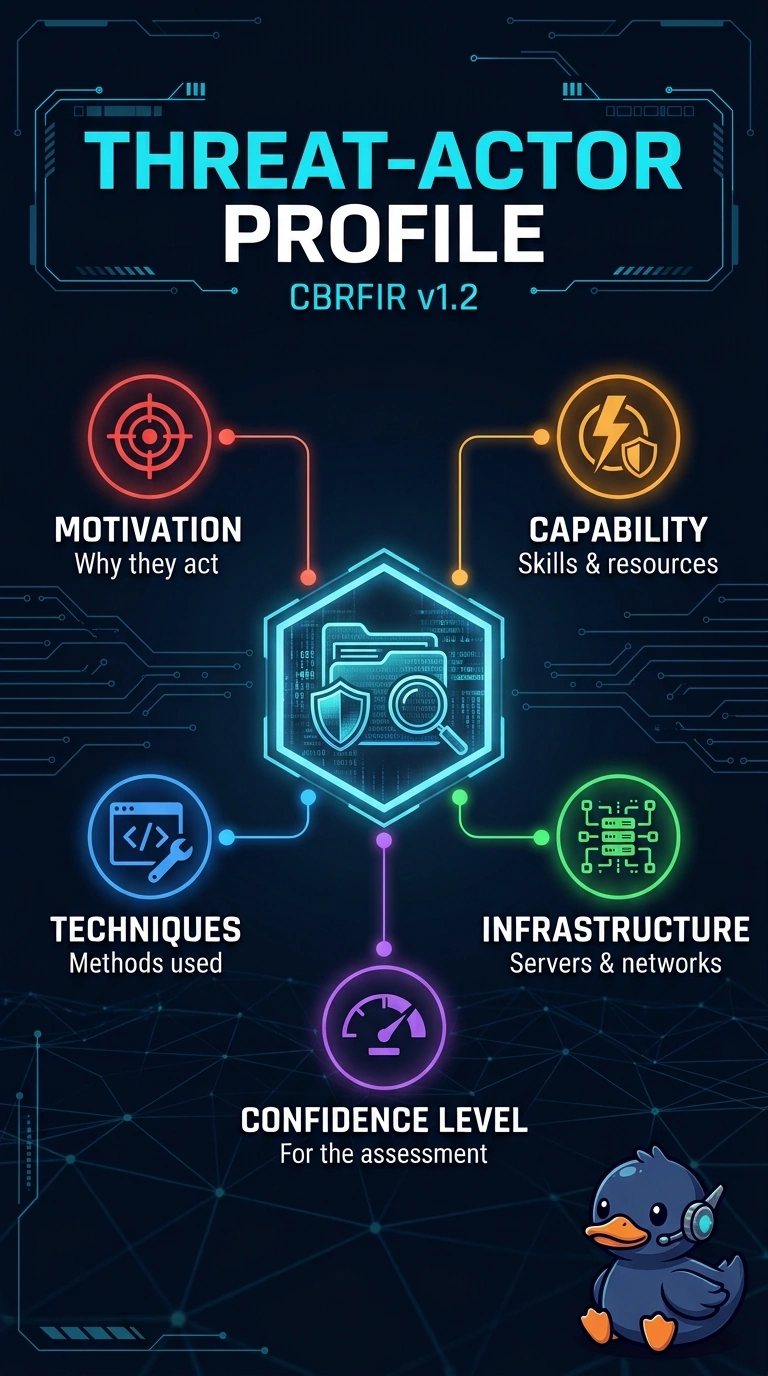
A useful dossier has room for why they act, what they can do, how they work, what they use, and how sure you are. You include motivation, capability, techniques, infrastructure, and confidence in the threat-actor profile. The trap is substituting one shared address, a brand name, or a handful of unrelated counts for that profile.
Full Explanation
A threat-actor profile is a structured judgment, not a single clue. The set that belongs is motivation, capability, techniques, infrastructure, and a stated confidence level for the assessment. Motivation says why they act, capability says what they can do, techniques say how they work, infrastructure says what they use, and confidence says how firmly the assessment is held. One shared address, a comment language, and a compile-time workday pattern offered as proof of sponsorship are weak clues, and offering them as proof skips the rest of the profile. The ransomware brand alone, with no mention that many affiliates may operate under that same brand name, collapses a service label into one operator. Firewall hit counts, a pagefile path, and the byte size of a single flow export taken during the incident are case metrics and file facts, not actor attributes. Exam caveat: unknown is an acceptable value for a field, and leaving confidence off the page makes a thin lead look settled. Operational check: read the draft and confirm each of those five fields is present, filled or explicitly unknown, before the profile is shared.