
An exploit aimed at a bank web service must be dropped on the network path at the data-center firewall. Which Cisco control does that job?
Select an answer to reveal the explanation.
Short Explanation
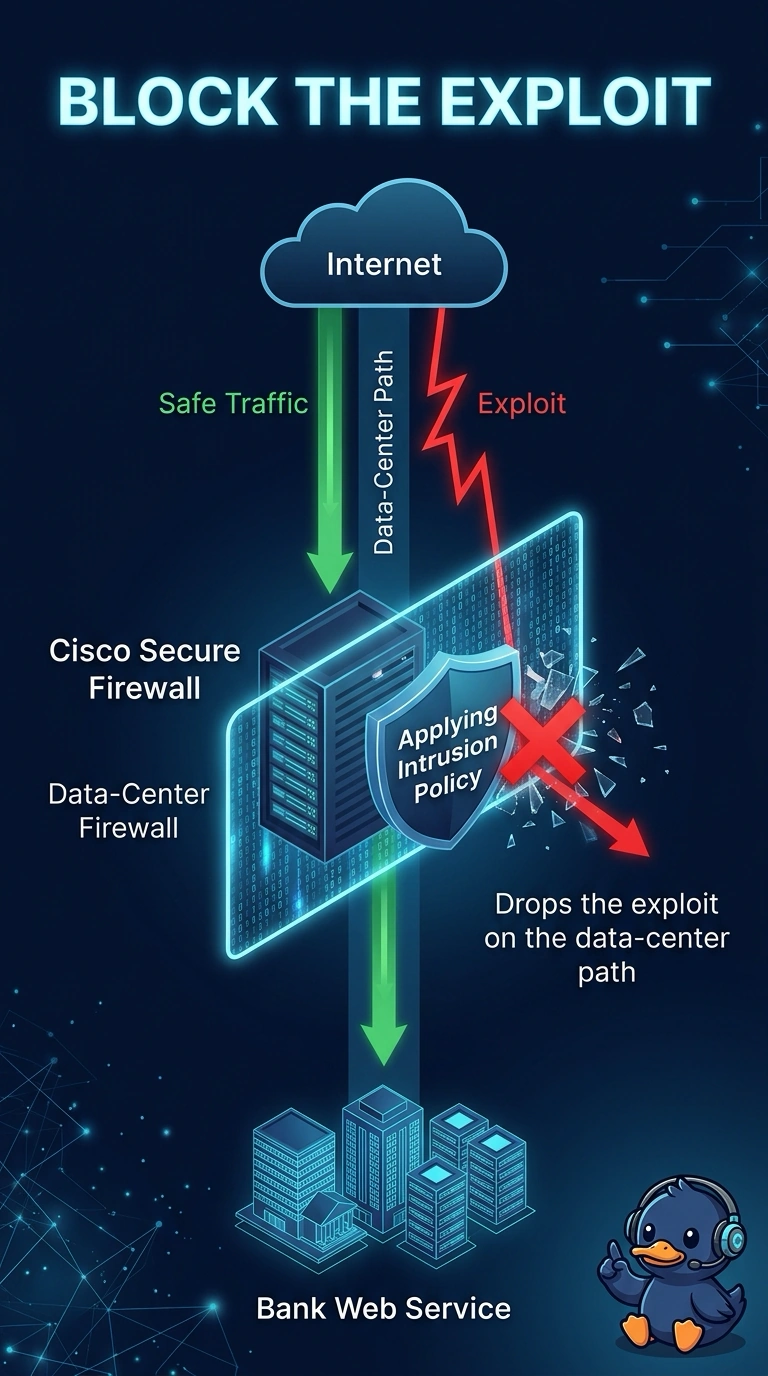
You need the guard standing in the doorway who can refuse the package, not the receptionist who only screens names. Secure Firewall can drop the exploit on the data-center path with an intrusion policy. Umbrella screens DNS, a sandbox is offline, and endpoint isolation does not stand on that firewall path.
Full Explanation
Cisco Secure Firewall, the Firepower family included, can sit inline on the data-center path and apply an intrusion policy that drops the exploit before it reaches the web service. That is a packet-path control, which is what the bank asked for. Cisco Umbrella, refusing the domain and expecting that DNS refusal to drop the exploit at the firewall, filters names at DNS and does not drop an exploit packet on the firewall path, especially when the attack is aimed at an address the client already has. Threat Grid, detonating the exploit offline and mailing a behavior list back toward the firewall, produces a sandbox report and does not sit on the live path to drop anything. Secure Endpoint, isolating laptops on the user network so the data-center path goes quiet, contains selected hosts and does not enforce an intrusion drop at the data-center firewall. Exam caveat: a drop happens when the matching intrusion rule is set to drop on an inline policy; a detection-only or monitor deployment will alert and still pass the packet. Operational check: confirm the data-center firewall policy is inline and the intrusion action for that exploit is drop, then look for a drop event on that firewall rather than a DNS block in Umbrella.