
Cashiers at a retail chain click emailed links, and those names resolve through external DNS before any HTTP proxy sees a request. Which Cisco control can stop that resolution?
Select an answer to reveal the explanation.
Short Explanation
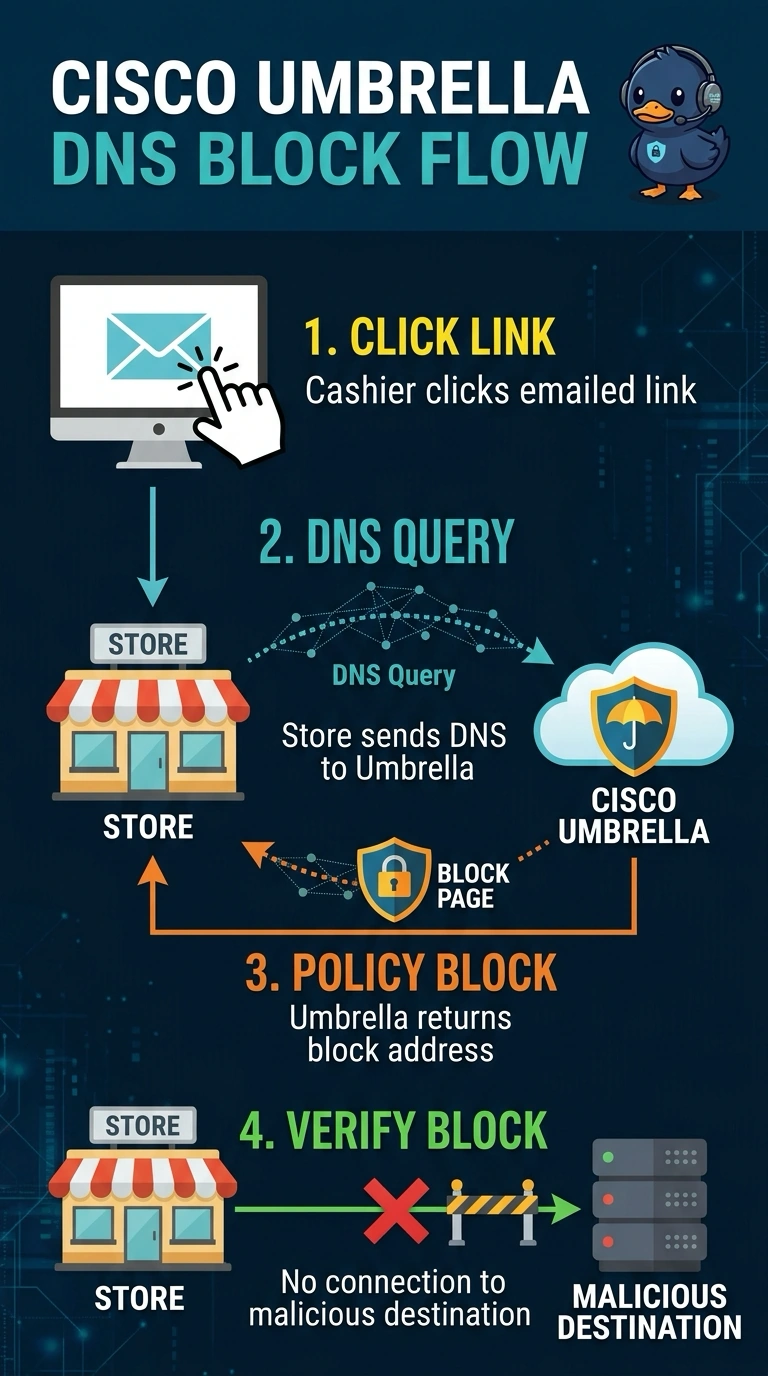
Picture the link as a phone call where you rely on Umbrella to intercept the lookup, not on a later page load. A blocked DNS request can return an Umbrella block-page address or another configured block response. Verify the policy block and absence of a connection to the malicious destination; a block-page connection does not mean the block failed.
Full Explanation
Cisco Umbrella DNS-layer security sits on the DNS path, returning a policy block response instead of the malicious destination’s address. A blocked DNS request can return an Umbrella block-page address or another configured block response. Verify the policy block and absence of a connection to the malicious destination; a block-page connection does not mean the block failed. Secure Firewall inspecting the web session only after the external name has already resolved can still block the later HTTP request, but the lookup itself already succeeded on external DNS, so the proxy was not in time to stop resolution. Secure Endpoint stopping the browser process only after the destination page starts to load reacts to a connection or a process, which is downstream of a completed lookup. Cisco XDR grouping the user click together with later proxy events as one incident record is correlation after the activity, not a control that answers DNS. Exam caveat: Umbrella can enforce the policy block only when the host or the store network actually sends DNS to Umbrella, not when a laptop uses a hard-coded external resolver. Operational check: confirm the register subnet forwards DNS to Umbrella, query a known blocked name, and verify the policy block response.