
A partner sends the city SOC a YARA rule and no list of addresses. What should that rule be run against?
Select an answer to reveal the explanation.
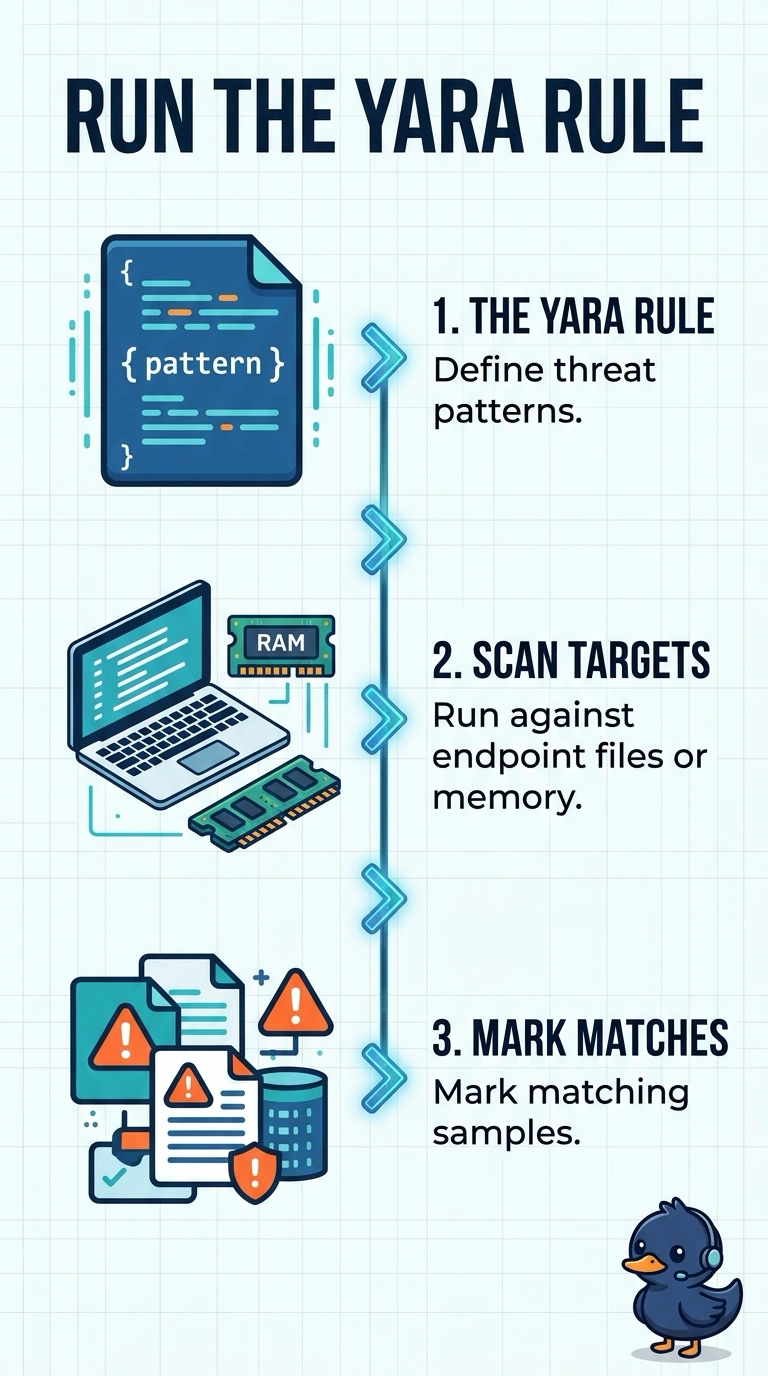
Short Explanation
A YARA rule is a pattern for bytes, closer to a metal detector than to a stack of banned plates. You run it against endpoint files or memory so the pattern marks matching samples. It will not import as a firewall address list, a DNS sinkhole, or a NetFlow filter on flow size.
Full Explanation
A YARA rule describes strings and a condition over bytes. Run the rule against endpoint files or memory so the pattern marks matching samples wherever those bytes exist. To import the rule as a firewall address list and deny every address it contains assumes the file is a set of addresses, which a pattern is not, and a firewall does not load rule syntax as an address object. To paste the rule into the DNS block list and sinkhole each string as a hostname treats arbitrary text as a domain and never scans the files the rule was written for. To apply the rule as a NetFlow filter that keeps flows under a chosen byte limit invents a threshold the rule does not state, and flow records are the wrong surface for a content pattern. The partner sent a pattern, so the work is a scan of files or memory. A hit still needs context before it is called the campaign rather than a lookalike. Exam caveat: a YARA match means the pattern was present, not that a firewall address was listed. Operational check: point the rule at a directory of collected samples or at an endpoint file set and record which samples it marks.