
Campaign intel for a factory incident is only a mutex name, with no addresses and no ports. Where should analysts search, and why is NetFlow the wrong store?
Select an answer to reveal the explanation.
Short Explanation
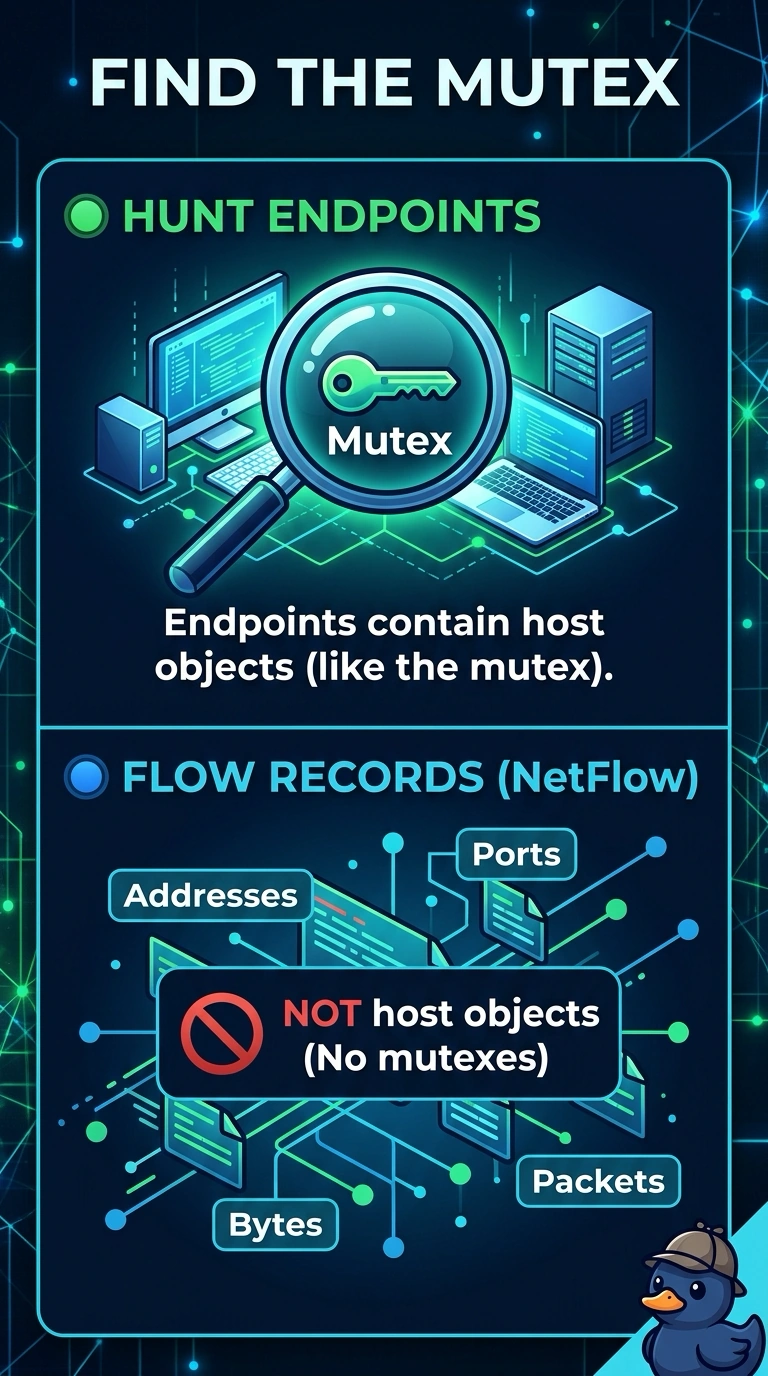
A mutex is a nameplate on a door inside one computer, and the highway toll log does not photograph nameplates. You hunt endpoints for that mutex because flow records carry addresses, ports, bytes, and packets, not host objects. A proxy block or a DNS publish sends you to a street that never saw the nameplate.
Full Explanation
A mutex is a host object created so programs can coordinate, and the name is visible to endpoint telemetry, process handles, or memory, not to the network record of a conversation. Hunt endpoints for that mutex. Flow records carry addresses, ports, bytes, and packets, and they do not carry host objects, so the name cannot be read back out of NetFlow. Searching the flow collector for mutex names beside byte and packet counters assumes a field the collector does not store. Blocking the mutex string on the web proxy treats it as a requested site path, which a kernel object is not. Publishing the mutex name in DNS so resolvers drop a domain tied to that object invents a domain the intel did not give you. Host artifacts are the layer that can show the named mutex and the process that created it, which is why the intel goes to the computer rather than the collector. Exam caveat: a mutex can be reused by benign software, so a hit is a lead to investigate on the host, not an automatic conviction. Operational check: search endpoint process or handle data for the mutex name and confirm the flow export has no column that could hold it.