
The firewall vendor publishes a temporary signature for an exploit while the application vendor still has no patch. What is the role of that virtual patch?
Select an answer to reveal the explanation.
Short Explanation
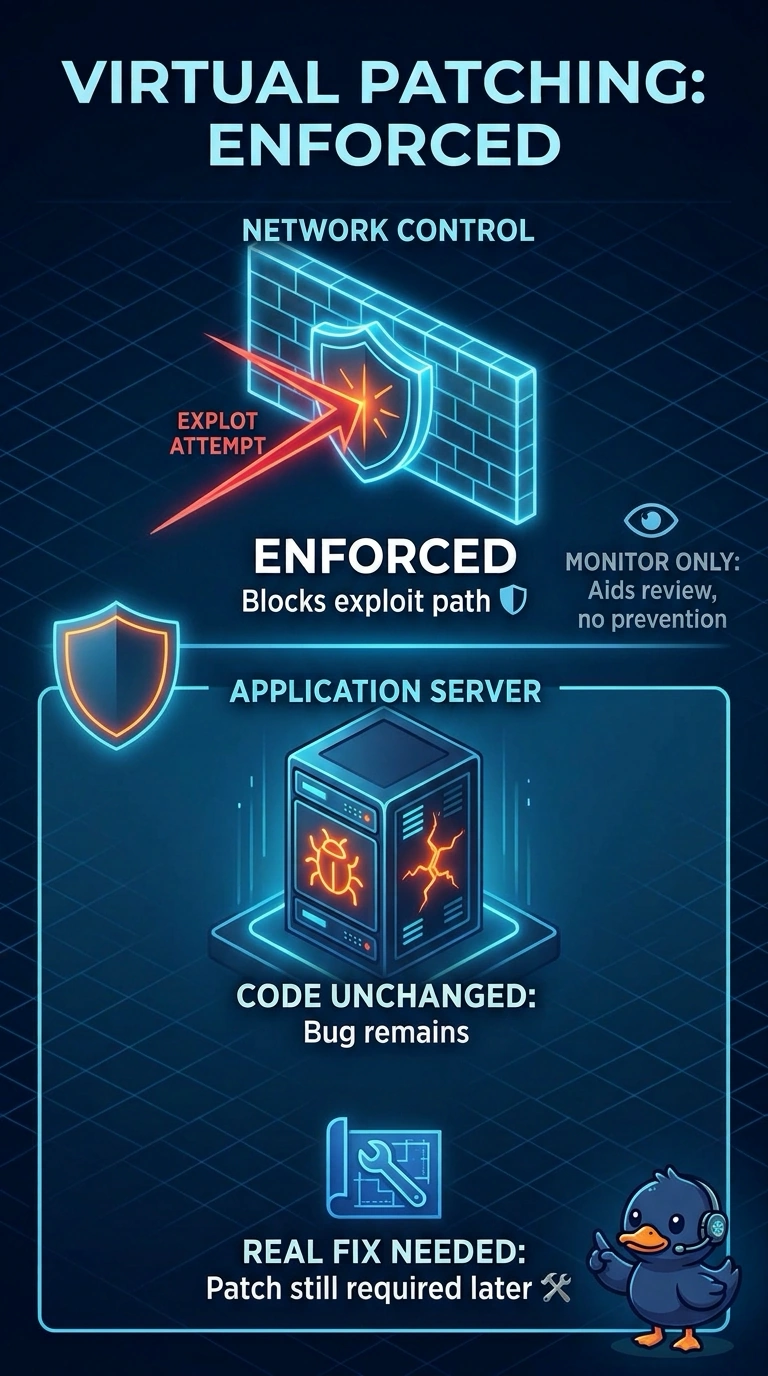
Think of a virtual patch as a guard at the door, not a repair of the broken lock. You get temporary protection when an enforcing network control blocks matching exploit attempts, but the application code stays unpatched and still needs the vendor’s fix.
Full Explanation
A virtual patch is an enforcing network control, usually an intrusion signature, placed in front of a vulnerable service while the application code remains unpatched. It blocks exploit attempts that match the signature, reducing exposure to the known attack pattern in transit; it does not remove the underlying bug. Rewriting the vulnerable function inside the application binary would repair the code, but a virtual patch does not modify the binary, so paths the signature misses—including local or altered attacks—may still reach the flaw. Retiring a later application patch is not appropriate: the signature is temporary cover until the vendor supplies a real fix, which remains necessary. Encrypting the server disk protects data at rest, not traffic to a running service, and therefore does not prevent an exploit pattern from matching in network traffic. Exam caveat: a signature may miss a variant that does not match its pattern, so virtual patching is not a completed repair. Practical check: confirm the signature is configured to block on the network path in front of the vulnerable service, and keep the application patch on the change schedule.