
A SIEM rule at a software company has matched a known lab scanning tool the same way for a month, and those hits are confirmed benign, while a separate live incident is still unreviewed. What tuning step is the responsible one?
Select an answer to reveal the explanation.
Short Explanation
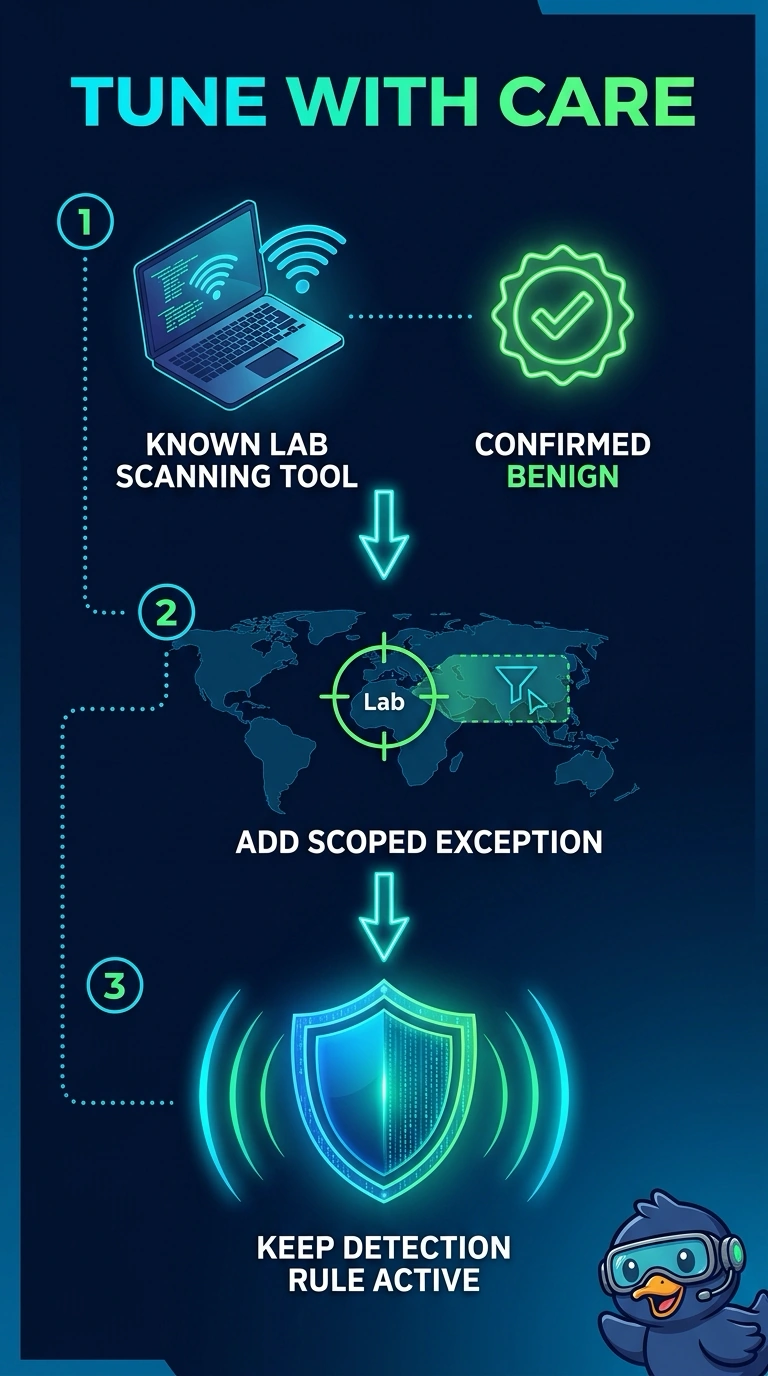
A smoke alarm parked next to a lab toaster needs a note on it, not a screwdriver during a real fire. You add a scoped exception for that confirmed lab tool and leave the rule up for the incident you have not finished reviewing. Deleting the rule to quiet the queue is how a second problem slips past.
Full Explanation
A rule that has been confirmed benign for one known lab tool should be narrowed, not removed, while a different incident is still open. The responsible step is to add a scoped exception for the confirmed lab tool and keep the detection rule active so other matches still alert. To delete the detection rule immediately so the unreviewed incident queue goes quiet blinds the team to the case they have not finished and to any future match of the same pattern. To raise the rule severity until analysts must open every lab-tool hit each morning adds noise; the hits are already confirmed benign and severity is not the defect. To convert the detection rule into an automatic block against every host that matches it turns a tuned detection into a broad enforcement action the scenario did not justify. Exam caveat: scope the exception to the known lab host or binary path, because an exception on the tool name alone can hide an attacker who copies that name. Operational check: after the exception, replay a synthetic match from a different host and confirm the rule still fires, then confirm the lab host no longer does.