
A school help desk quarantined a malicious hash on the single laptop named in the ticket. What must finish before that incident is called contained?
Select an answer to reveal the explanation.
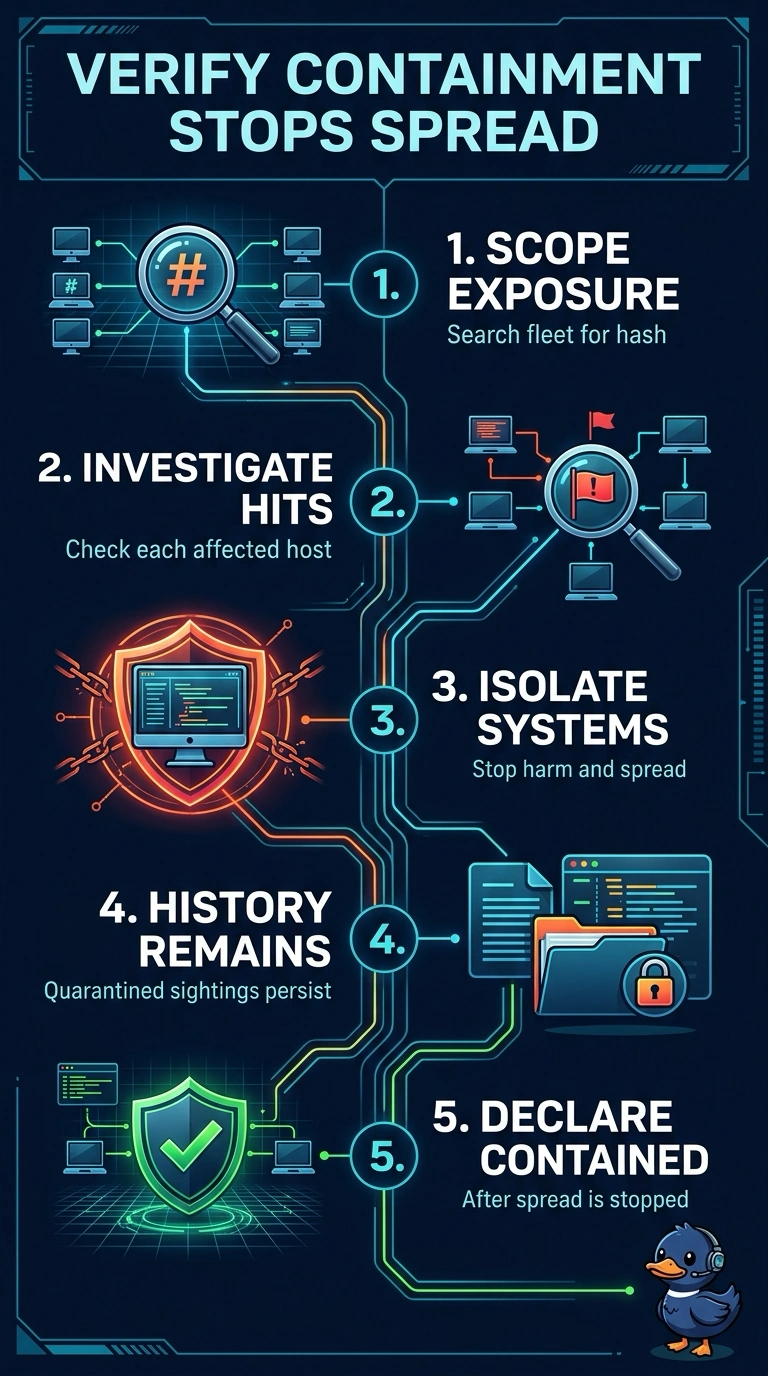
Short Explanation
Think of quarantine on one school laptop as locking one door, not checking the whole hallway. You need a scoped investigation: use fleet search to find potential exposure, investigate hits, and verify affected systems are isolated or otherwise constrained so harm and spread stop. Historical or quarantined file sightings may remain, so you can’t rely on the ticketed laptop, a deleted local copy, or a clean console display to speak for the rest of the fleet.
Full Explanation
Containment means ongoing harm and spread are stopped across the affected scope, not merely that a quarantine action occurred. Complete a scoped investigation to identify potentially affected hosts and verify that each is isolated or otherwise constrained. Use fleet search to scope potential exposure, investigate hits, and verify effective containment on affected systems; historical or quarantined file sightings may remain after containment. A fleet search alone does not equal containment: it scopes exposure, while isolation or other constraints stop spread. File trajectory on the reported laptop shows where the hash was seen on that device and can help scope the investigation, but it does not prove that other systems are constrained. Treating quarantine on the reported laptop as enough mistakes one host action for control of the whole incident and leaves other affected systems free to spread harm. Returning the laptop to the classroom after removing its local quarantine copy restores access without verifying that spread is stopped. A clean console status on that laptop is not proof of control across other affected hosts and may not reflect historical sightings. As an exam caveat, sightings can remain after containment, so their presence alone does not show that spread continues. In practice, check the fleet search results, investigate the hits, and verify the affected hosts’ isolation or other constraints.