
Cisco Secure Network Analytics flags one branch host beaconing to an external address while the rest of that subnet stays quiet. Endpoint investigation confirms a malicious process owns those sessions and the destination is an active command-and-control endpoint. Which containment matches that evidence?
Select an answer to reveal the explanation.
Short Explanation
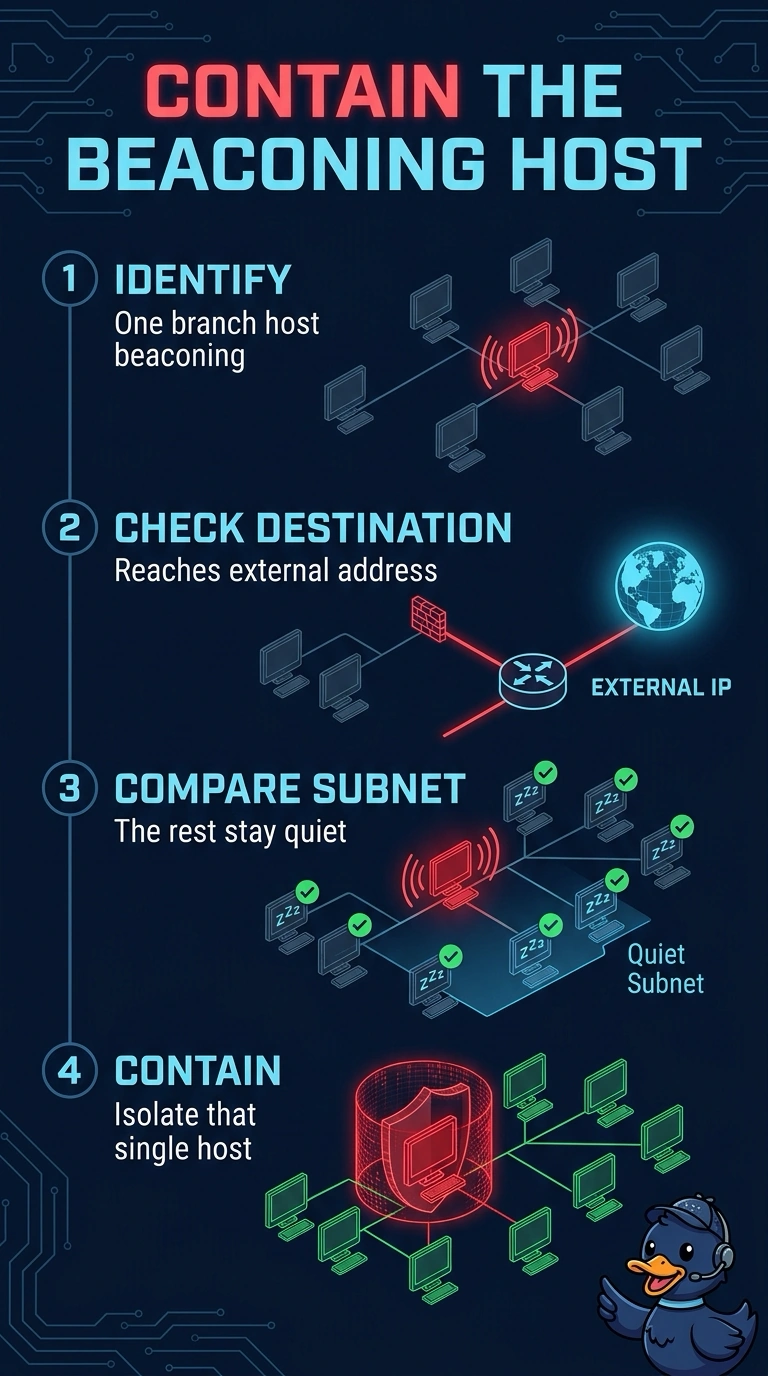
Corroborated malicious activity on this one host supports targeted containment; periodic traffic alone is not proof of compromise. You now have endpoint proof that a malicious process is talking to an active C2 while the rest of the subnet stays quiet, so you contain just that host. You leave the quiet subnet up and you do not block all web traffic or brush it off as normal mail.
Full Explanation
Corroborated malicious activity on this one host supports targeted containment; periodic traffic alone is not proof of compromise. Cisco Secure Network Analytics flags one branch host beaconing to an external address while the rest of that subnet stays quiet. Endpoint investigation confirms a malicious process owns those sessions and the destination is an active command-and-control endpoint. That corroboration makes containing the single beaconing host that reaches the external address while the subnet stays quiet the proportionate response, stopping command-and-control without needless outage. Taking the entire subnet offline on the theory that one beacon compromises every other host overreacts, isolating quiet peers with no malicious sessions. Blocking company-wide outbound web traffic until that external address is fully retired from use punishes every site for one talker and one destination and does not remove the compromised process. Disregarding the host on the theory that scheduled mail checks normally look like beaconing dismisses endpoint proof of malicious ownership and an active command-and-control endpoint as benign periodicity.