
Malware on one publisher host ran under an admin account, and that same account had also logged on to ten other hosts. How wide should the credential reset reach?
Select an answer to reveal the explanation.
Short Explanation
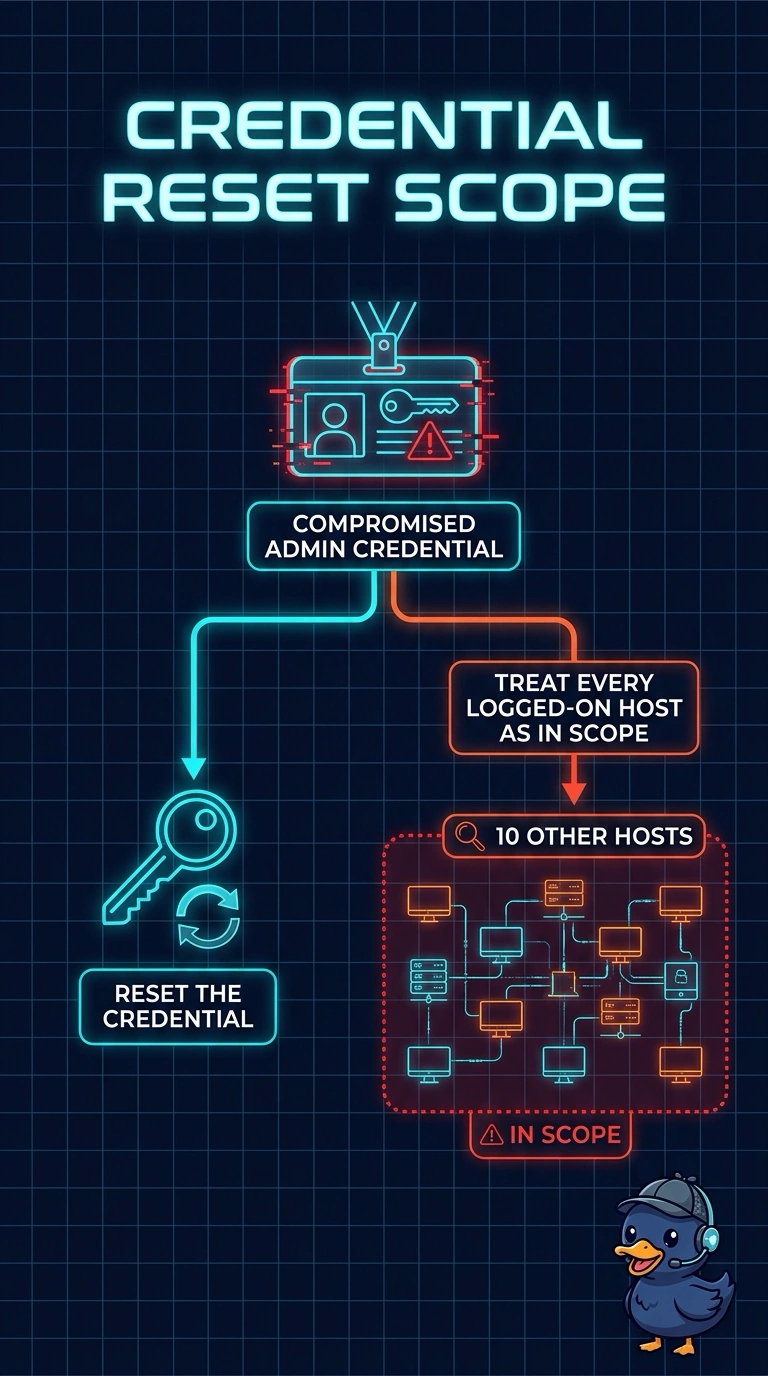
Changing the lock on one door does not help if the same master key opened ten others. You reset that admin credential and treat every host it logged on to as in scope. Stopping at the single host named in the command line leaves the rest untouched.
Full Explanation
The malware command line shows the admin credential on one host, and the same account logged on to ten other hosts, so the attacker may have used it in all of those places. You reset that admin credential and treat every host the account logged on to as in scope, including the ten others, then revoke sessions so an old login cannot continue. Changing only one host local account leaves other reused local credentials valid. A domain-account password is reset centrally once, regardless of the workstation used to initiate it; investigate all affected hosts and separately revoke sessions/tokens as supported. Keeping the same admin password and isolating only the one host that actually ran the malware stops one machine and leaves the credential live. Deleting the admin profile on the one host and skipping a password change removes a local folder and does not invalidate the credential on the other hosts. Exam caveat: a directory account is reset once in the directory, while a local password reused on each host must be changed on each host; either way the ten other logons stay in the investigation scope. Operational check: list every host that accepted that account during the dwell window, reset or rotate the credential, and confirm old sessions on those hosts are gone.