
A customer login portal is receiving many failed passwords from a wide set of sources. What should be gathered first, instead of imaging every employee desktop?
Select an answer to reveal the explanation.
Short Explanation
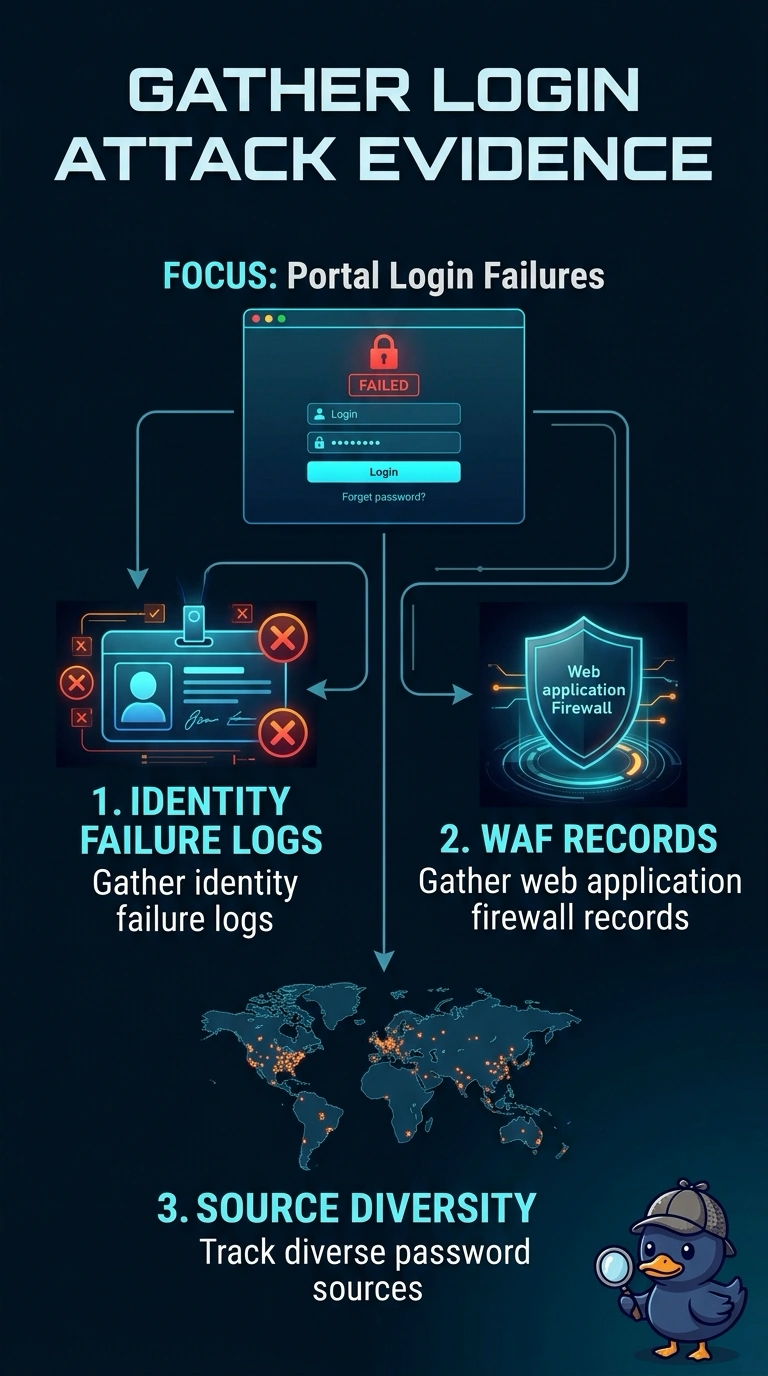
A crowd guessing passwords at the front gate is not a reason to photograph every desk inside. You start with identity failure logs, the web application firewall, and how widely the sources are spread. Imaging the desktop fleet first delays the records that actually describe this attack.
Full Explanation
These observations show a distributed authentication-attack pattern; identify credential stuffing only when evidence supports reuse of stolen credential pairs, and also consider password guessing or spraying. Identity failure logs, the web application firewall records, and the diversity of sources trying passwords show which accounts are targeted, what the firewall saw, and whether the sources are broadly distributed rather than one internal host. A memory image of every employee desktop, collected before the portal logs or the firewall records are opened, assumes a fleet compromise the evidence has not shown and postpones the records that describe the attack. The gold-image hash of the portal server alone, with no review of failures or source addresses, checks build integrity and says nothing about the password attempts. A sandbox detonation of the login page to decide whether the portal software itself is hostile treats the site as malware instead of as the target. Exam caveat: if a guessed password then succeeds and that account is used on a specific host, that host can be scoped later; the opening collection is still the identity log, the firewall, and the sources. Operational check: count failures by account and by source in the identity log and the web application firewall, and note whether those sources are many and unrelated.