
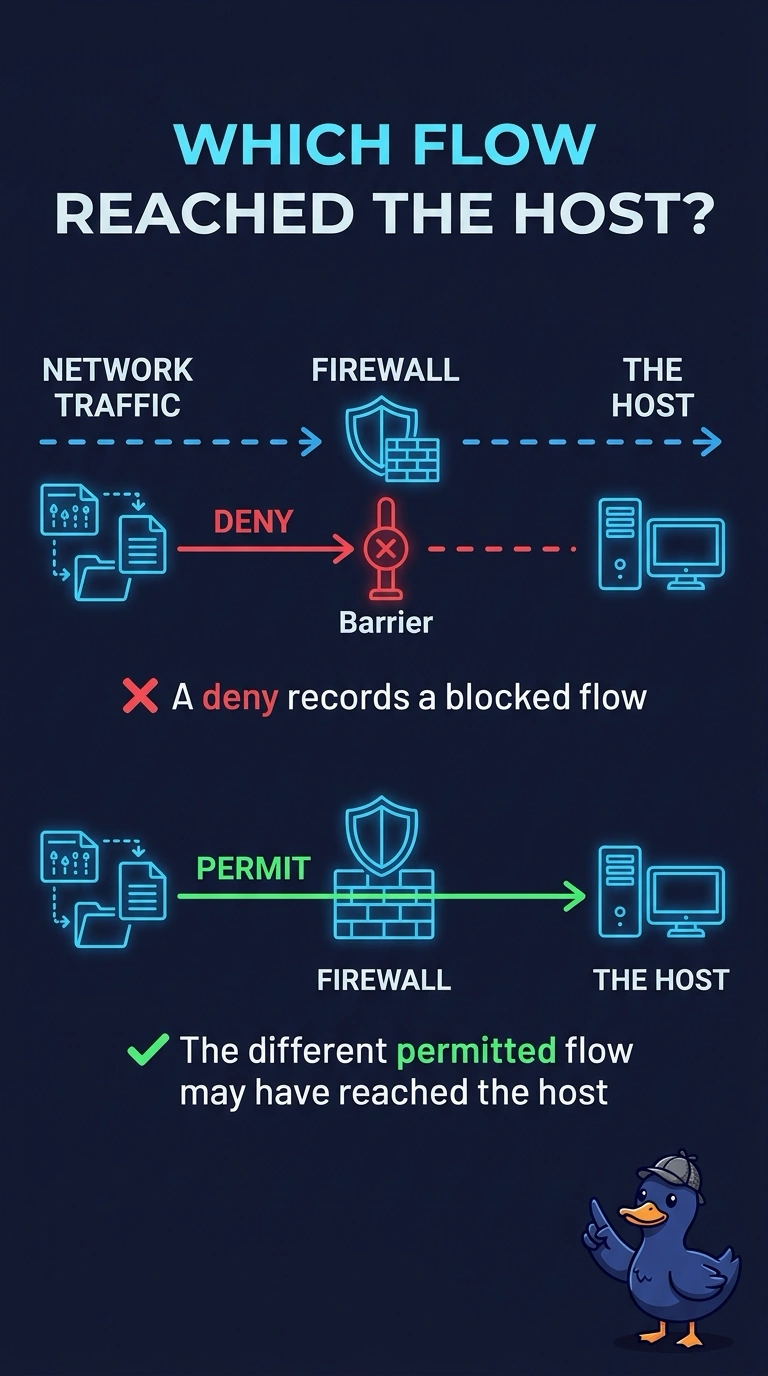
A factory firewall log records a deny for one flow, while an intrusion alert refers to a different flow that the firewall permitted. Why is that deny line not the successful intrusion?
Select an answer to reveal the explanation.
Short Explanation
A locked front gate does not tell you the side door was also shut. You treat a firewall deny as a blocked flow, and you investigate the different flow that was permitted. The trap is reading any deny as proof the intrusion failed.
Full Explanation
The deny records enforcement at that decision point; application identification can require earlier packets to pass. Investigate the separate permitted alert flow and check action timing/packet evidence before claiming that no bytes from the denied connection ever reached a host. That is why the deny line is not the successful intrusion: the enforcement is on one connection, while the alert refers to a different connection that was permitted and therefore is the one that may have reached the host. The idea that a denied packet still delivers its payload to the internal host before logging reverses enforcement; the deny is the decision to not forward that packet, even though earlier packets for identification might have passed, and log order does not create delivery. The idea that the deny and the alert describe one flow whenever both appear during the same shift merges connections by time; the scenario already separates them by action and five-tuple, and proximity in time does not merge two flows. The idea that any deny lets permitted flows be skipped assumes policy success on one flow protects another; a block on one flow says nothing about a different allowed flow. Exam caveat: an intrusion signature on the permitted flow tells you which flow to investigate, not proof exploit succeeded. Operational check: compare action, source, destination, and ports on the deny line with the same fields on the alert.