
During a retail investigation, the SIEM shows an intrusion-detection alert and a host log for the same packet, yet the recorded times differ by hours and one source is labeled UTC. What must be corrected before those events are placed in order?
Select an answer to reveal the explanation.
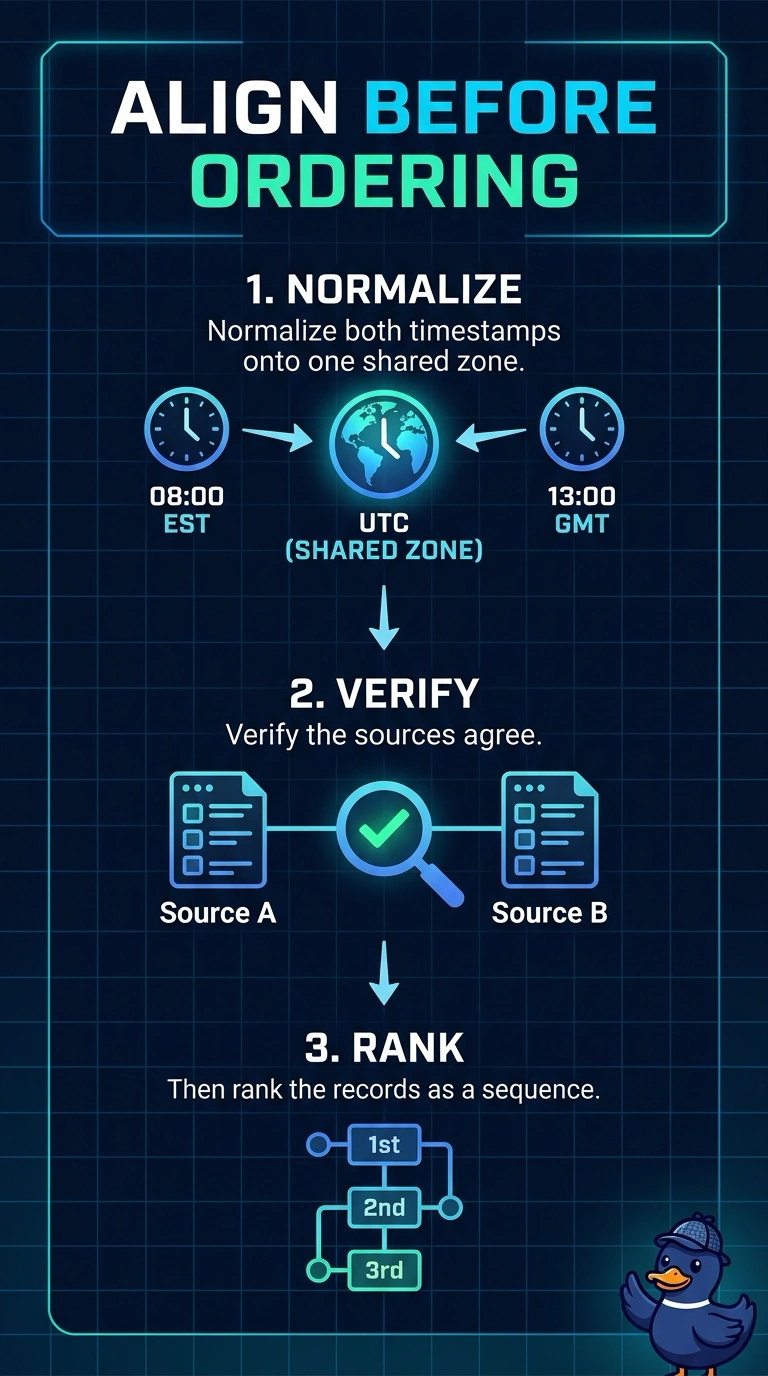
Short Explanation
Picture two shop clocks in different cities both ringing for the same delivery truck. You cannot sort those rings until the clocks share a zone, or a label shift looks like a long pause. The mistake is to throw out the host record just because its face shows a later hour.
Full Explanation
An intrusion-detection alert and a host log can describe one packet and still disagree when one clock is labeled UTC and the other is local. Normalize both timestamps onto one shared zone, verify the sources agree on that same packet, and only then begin ranking the records as a sequence. The difference may reflect time zones, clock skew or collection delay; preserve the original values, normalize known offsets, verify clock accuracy and confirm what each timestamp represents before inferring sequence. To discard the host log on sight of a later clock time throws away the endpoint half of the event; a later clock often means a shifted zone, not an intrusion alert record too late to trust. To treat the gap as proof the host stayed offline until its local entry was written invents an outage the packet does not show, and the host can be up the entire time its clock is wrong. To label the alert a replay solely when the two clocks fail to display the same hour confuses correlation with duplication; a mismatched display is not a second copy of the packet. Exam caveat: ordering the times still does not prove the payload succeeded, only that the observations can be sequenced. Operational check: note the zone on the alert and the host log, convert both to the same zone, and match packet identifiers before the timeline is published.