
A retail IPS event for a known exploit signature shows the action was dropped. How does that result differ from the same signature configured to alert only?
Select an answer to reveal the explanation.
Short Explanation
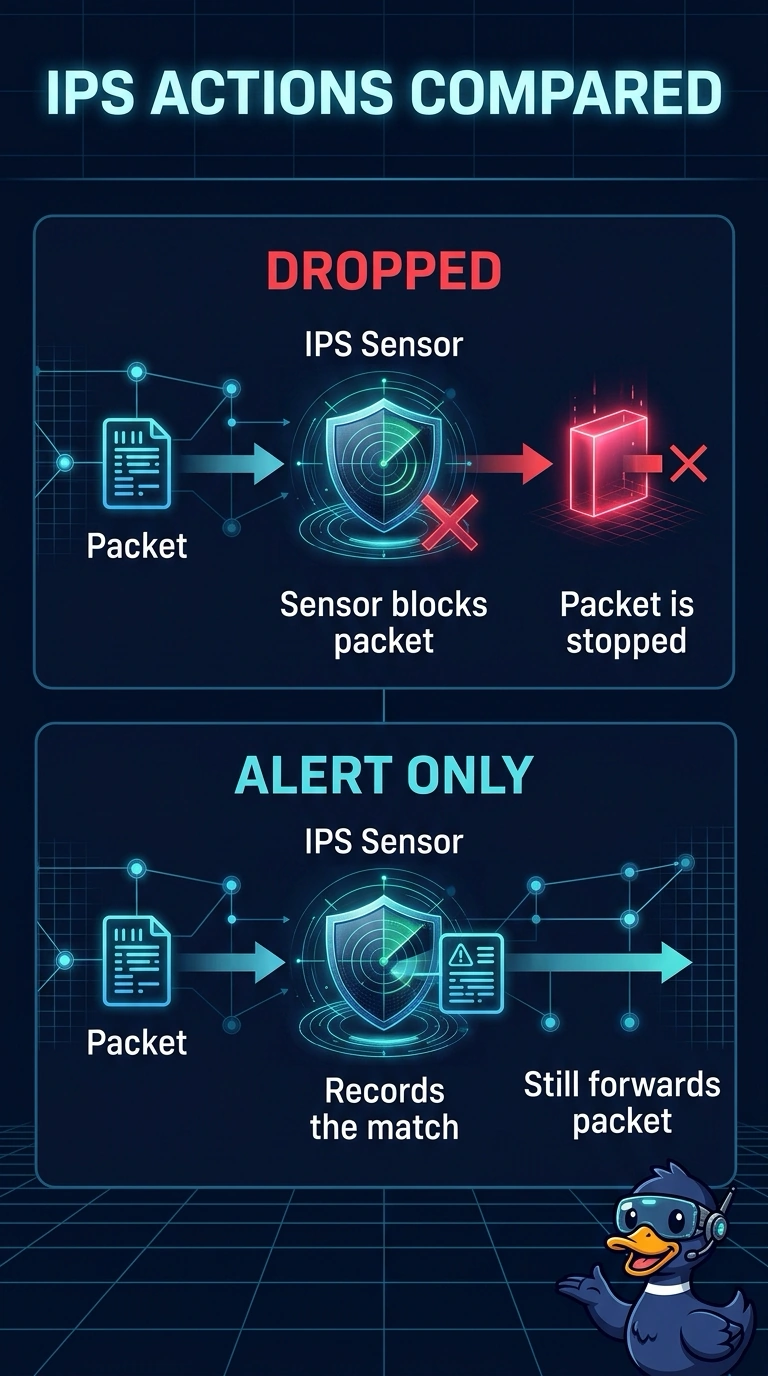
Think of a dropped packet as a door that stayed shut, and an alert-only rule as a doorbell that lets the visitor through. You can see the sensor blocked this packet, whereas alert only would record the match and forward it. The trap is treating both actions as the same block, or treating a block as proof the server was already exploited.
Full Explanation
When the IPS action is dropped, the sensor blocked that packet so those bytes did not continue to the target. The same signature configured to alert only would record the match and still forward the packet, leaving the destination to face the content. Dropped means a block; alert only means a logged pass. Dropped and alert only do not both stop the packet, and they do not differ only by the color of the syslog line; the action field is the difference that matters. Alert only does not remove the flow from history, and dropped does not exist to keep the payload ready for court review; one records a forwarded match, the other blocks. Dropped does not prove the server was exploited, and alert only does not mean the sensor itself was offline; a block shows the inline action fired, not a completed exploit or a dead sensor. Exam caveat: a drop shows this packet was stopped, and it does not show whether an earlier packet with the same signature was allowed. Operational check: read the action field on the IPS event. For alert-only events, correlate network delivery with host process, application and file evidence; a network signature ID is not generally a host-log field.