
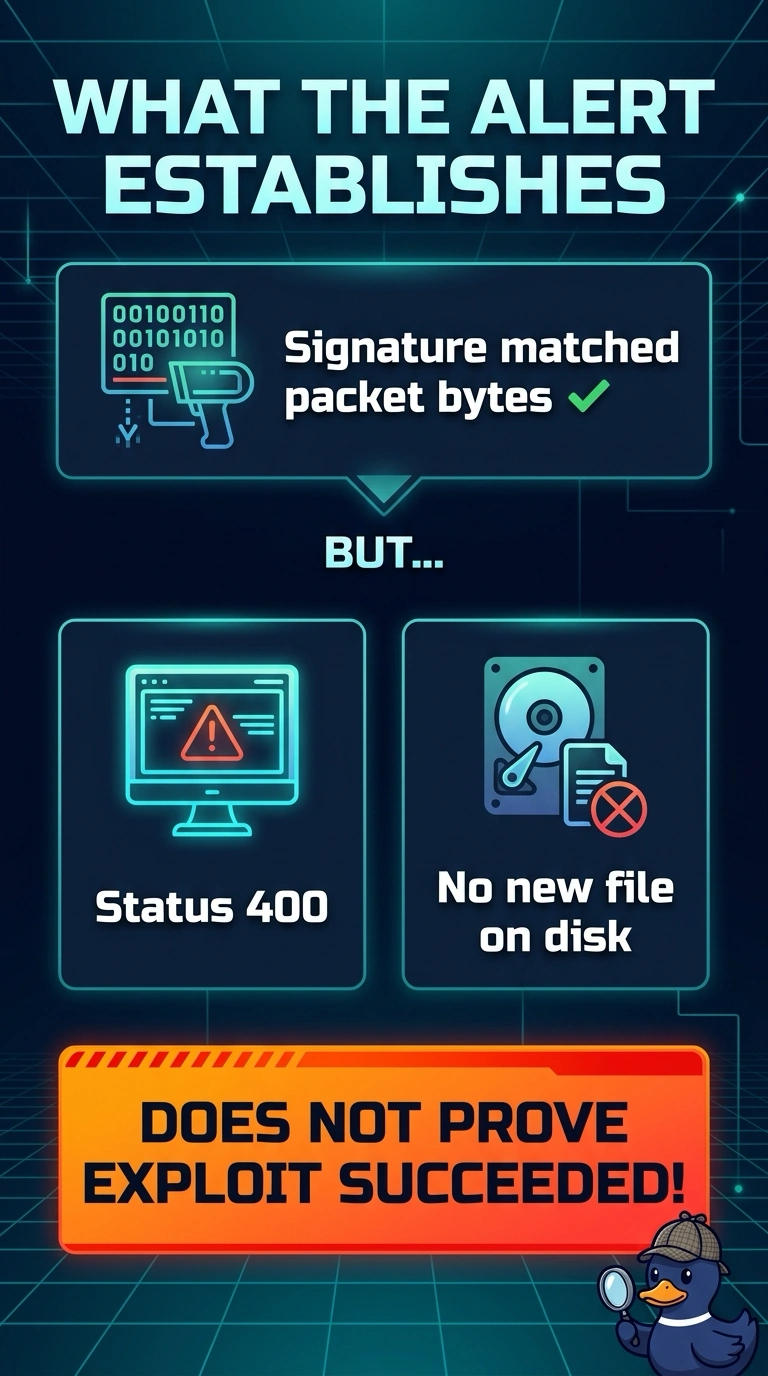
An IDS alert says an exploit signature matched a packet sent to a clinic web server. The server log for that request shows status 400 and no new file on disk. What does that alert establish?
Select an answer to reveal the explanation.
Short Explanation
A signature match is a smoke alarm, not a photograph of a fire already burning the server. You have evidence the sensor saw exploit-like bytes, and status 400 with no new file does not show the exploit succeeded. Do not treat the alarm as ownership, and do not throw it away without a look.
Full Explanation
An IDS signature match shows that packet bytes fit a known exploit pattern. It does not show that the web server executed the payload. Status 400 is a client-error response, and the absence of a new file means this evidence does not prove the exploit succeeded. The signature matched packet bytes, and that match is the whole of what the alert establishes. The claim that the server executed the exploit and wrote a file the access log simply skipped assumes success the log does not show; a skipped file is speculation, not a finding. A matching exploit signature does not mean the server is fully compromised and controlled, because a pattern match is not a completed intrusion. Calling the alert handshake noise and closing the packet without reviewing the request throws away a real match; noise is a conclusion reached after the request, the status, and the host are compared, not before. Exam caveat: a client-error status does not prove every payload was harmless, and it does mean this log plus the missing file fail to prove success. Operational check: compare the IDS packet time and source with the web log status, and confirm whether any new file or child process appeared then.