
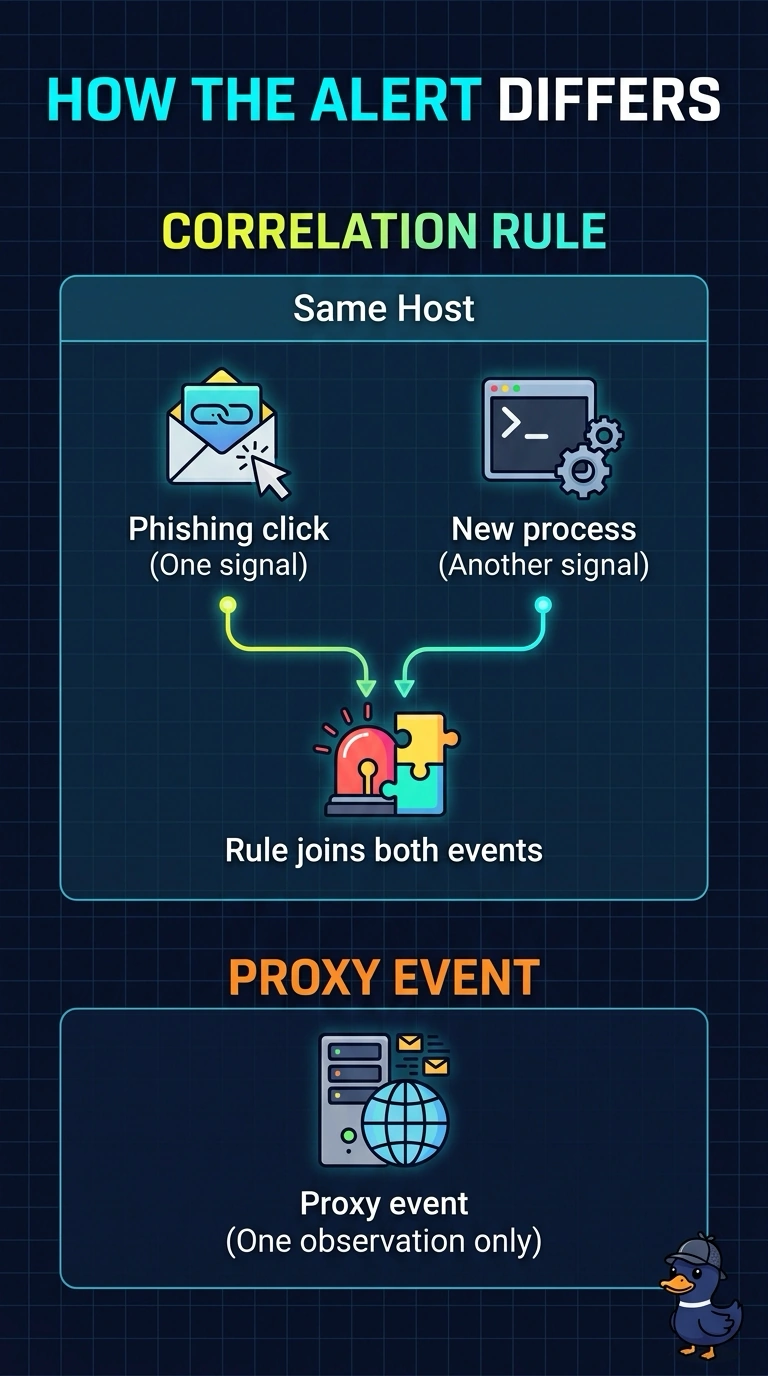
A SIEM correlation rule fired only after a phishing click and a new process on the same host. How does that alert differ from one raw proxy event for the clicked address?
Select an answer to reveal the explanation.
Short Explanation
One overheard sentence is a clue, and two matching statements are a case starting to take shape. You have a rule that joins a phishing click with a new process, which is more than one raw proxy event standing alone. Do not treat that single proxy line as proof the malware ran, and do not treat the rule as a decoration that erases the log.
Full Explanation
A correlation rule fires only when every required piece is present. This rule joins the phishing click with the new process on the same host, so the alert is a combined observation. One proxy event is only a single observation of a request; it does not include the process that started afterward. The single proxy event does not already prove the malware ran, so the correlation rule does add something useful to the case: the join itself. The correlation rule does not delete the proxy record, and it does not replace that record with a colored severity icon on the dashboard; the underlying events remain for review. A raw proxy event is not already a confirmed incident, and the correlation rule is not only a dashboard decoration; you still read what the joined events show. The join is the difference a lone proxy line does not have. Exam caveat: correlation raises confidence by requiring more than one event, and it does not remove the need to inspect those events. Operational check: open the rule, list the required conditions, and compare that list with the single proxy record for the clicked address.