
Two security products exchange STIX by way of TAXII, and a colleague says an emailed STIX file already does the same job. What does TAXII add at the level of automated exchange?
Select an answer to reveal the explanation.
Short Explanation
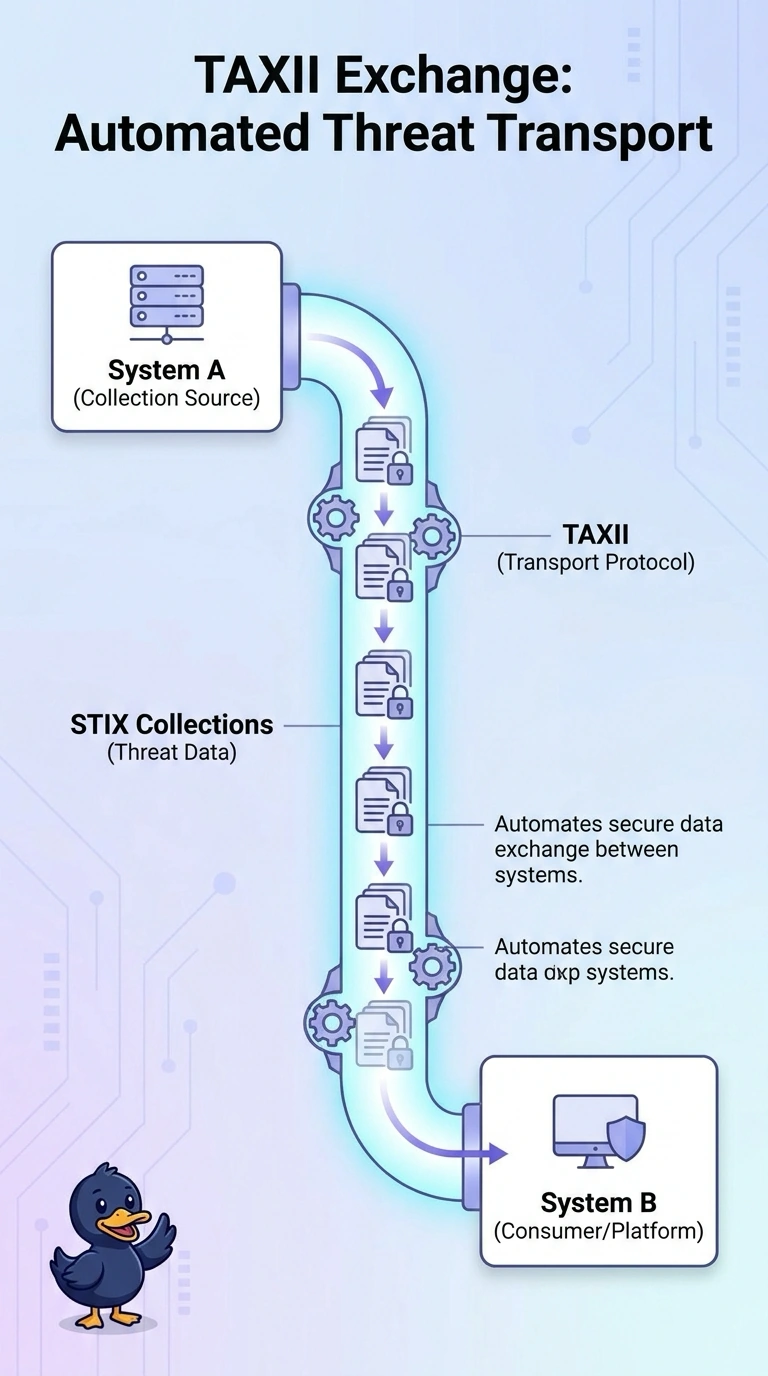
When you need security products to keep exchanging STIX collections automatically, you need a transport between them, not just a file passed along once. TAXII provides that transport; rewriting indicators into firewall signatures, encrypting objects, or emailing a STIX file does not create an automated exchange channel.
Full Explanation
TAXII transports STIX collections between systems, providing a channel that allows two products to exchange them automatically. A STIX file attached to an email still uses the same STIX model. An emailed file alone does not establish TAXII-compatible discovery and collection APIs; email workflows can also be automated, but do not thereby implement TAXII. TAXII does not rewrite each STIX indicator into native firewall signature syntax: translating an object into a signature is a separate process. Nor does TAXII encrypt objects so that an emailed copy stops counting as intelligence; encryption and the difference between a protocol and a mailbox are not the point of the exchange. An emailed STIX file therefore does not provide the same automated collection exchange as TAXII, because sending a copy is not a standing channel between systems. Exam caveat: TAXII moves the objects but does not decide whether an indicator should be blocked; the consuming product must still enforce it. Practical check: identify the TAXII collection shared by the products and verify that indicators arrive through that channel rather than as a single emailed attachment.