
An analyst at a school placed a suspected actor motivation inside an indicator pattern. Which STIX object type is meant to hold that actor information?
Select an answer to reveal the explanation.
Short Explanation
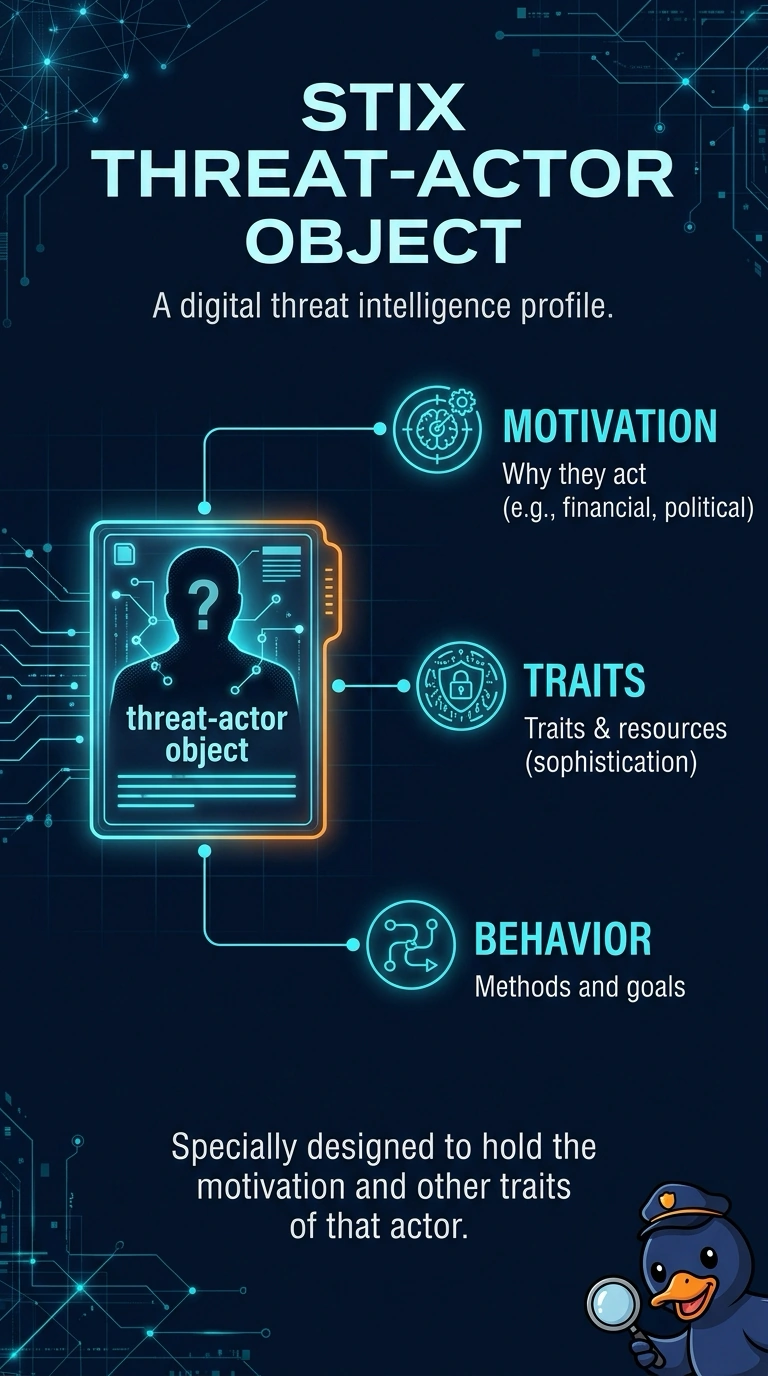
A person's motive belongs on the dossier, not inside the recipe you use to spot them at the door. You put suspected motivation on a threat-actor object, not inside an indicator pattern. The trap is stuffing actor traits into an indicator, a malware object, or a TAXII collection.
Full Explanation
STIX splits the actor from the things used to detect or describe malicious software. A threat-actor object is the type meant to hold motivation and the other traits of that actor, such as goals and a sense of capability. A pattern names observables, for example a hash or an address, and it is not a paragraph about why the actor operates. An indicator object is the wrong place: the pattern field is a detection expression, not a biography, so it should not be used as the place to keep suspected motivation prose. A malware object describes software. Putting sponsor goals on it in place of the traits of the software itself swaps an actor for a program. A TAXII collection is a transport container. Keeping motivation as metadata describing the transport channel itself stores a profile fact on the pipe that moves objects, where consumers will not read it as an actor. Exam caveat: a relationship can connect a threat-actor object to a malware object or an indicator, and the motivation still lives on the threat-actor object rather than in the pattern. Operational check: move the motivation sentence onto a threat-actor object and leave the indicator pattern as a detection expression only.