
A retail security team finished a STIX bundle of phishing domains, but the perimeter firewall only accepts address lists and signatures. What still has to happen before those domains can be blocked there?
Select an answer to reveal the explanation.
Short Explanation
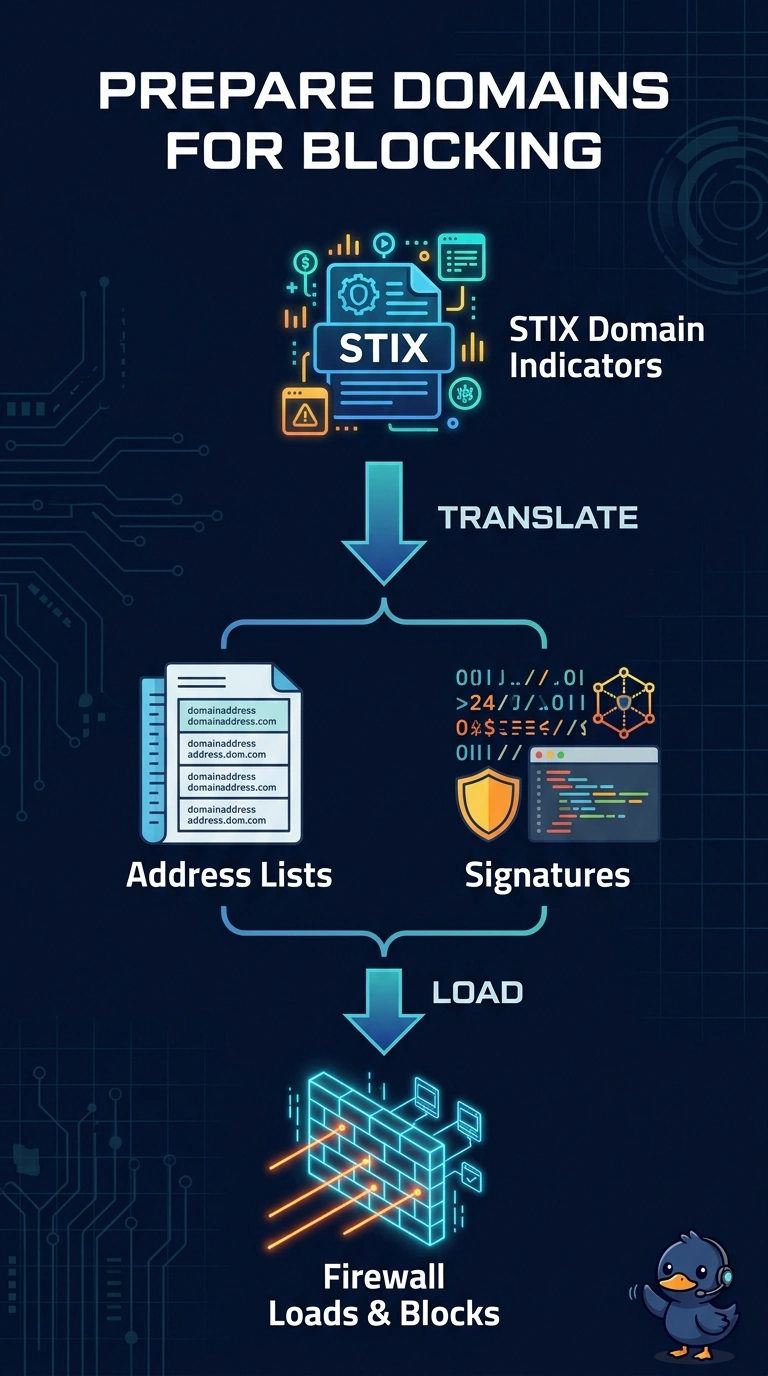
A phrase book does not help if the guard at the gate reads a different language, and you still have to translate. The firewall loads lists and signatures, so the domain indicators in that STIX bundle have to be rewritten into one of those formats. Leaving the bundle as STIX, or hoping TAXII compiles it into rules, skips the step the firewall actually enforces.
Full Explanation
Those domains become enforceable after you translate the domain indicators into the list or signature format the firewall loads. The bundle can be valid STIX and still sit unused if the appliance does not receive a native object it understands. If you upload the STIX bundle unchanged and expect the firewall itself to block those domains, you are counting on a STIX parser this scenario does not give you. If you email the bundle and treat that message as live policy, delivery to a mailbox is not an install on the firewall. If you expect TAXII to produce firewall rules with no mapping step, you have mixed transport up with the control that actually drops traffic. A list entry or signature is something the firewall can evaluate on live traffic, whereas a STIX object stays inert until that translation exists. Exam caveat: translating a domain into a list entry does not prove any host already talked to it; it arms the firewall for the next match. Operational check: export the firewall list or signature set and confirm the phishing domains appear as native entries rather than as a STIX attachment.