
An analyst renames a CSV of addresses so the name ends in a stix extension and shares it as finished intelligence. Why is that file not yet STIX?
Select an answer to reveal the explanation.
Short Explanation
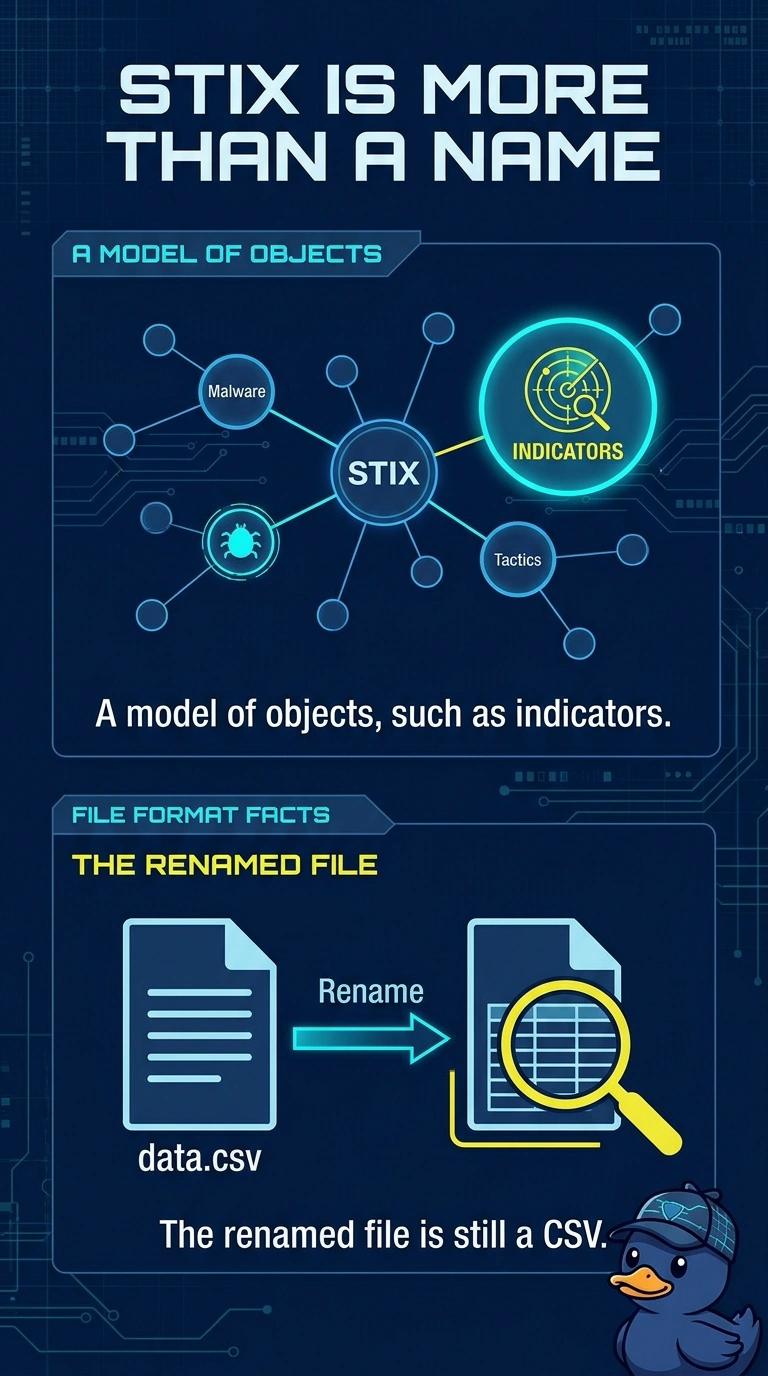
Changing the label on a jar of screws does not turn the screws into a watch, and you still have the screws. STIX is a model of objects such as indicators, so a CSV of addresses renamed with a stix extension is still a CSV. An extension does not create a TAXII collection, a mailed list is not suddenly STIX, and a firewall will not treat those rows as native signatures merely due to the name.
Full Explanation
STIX is a model of objects such as indicators, and the renamed file is still a CSV. The extension on the name does not change rows of addresses into indicator objects or relationships. It is false that the stix extension converts each address row into a TAXII collection entry; TAXII moves collections, and a rename does not create one. It is false that a plain text list of addresses becomes STIX once it is mailed to another response team; mailing a CSV distributes a CSV. It is false that the new extension instructs the firewall to load the rows as native signatures; a filename change does not install signatures. Indicator objects carry structured fields and can link to other objects, while a row of addresses has none of that structure no matter what you name the file. Exam caveat: you can build real indicator objects from those addresses later, and the renamed file is not that build. Operational check: open the file, confirm you see comma-separated addresses, and confirm you do not see indicator objects with the fields a STIX indicator carries.