
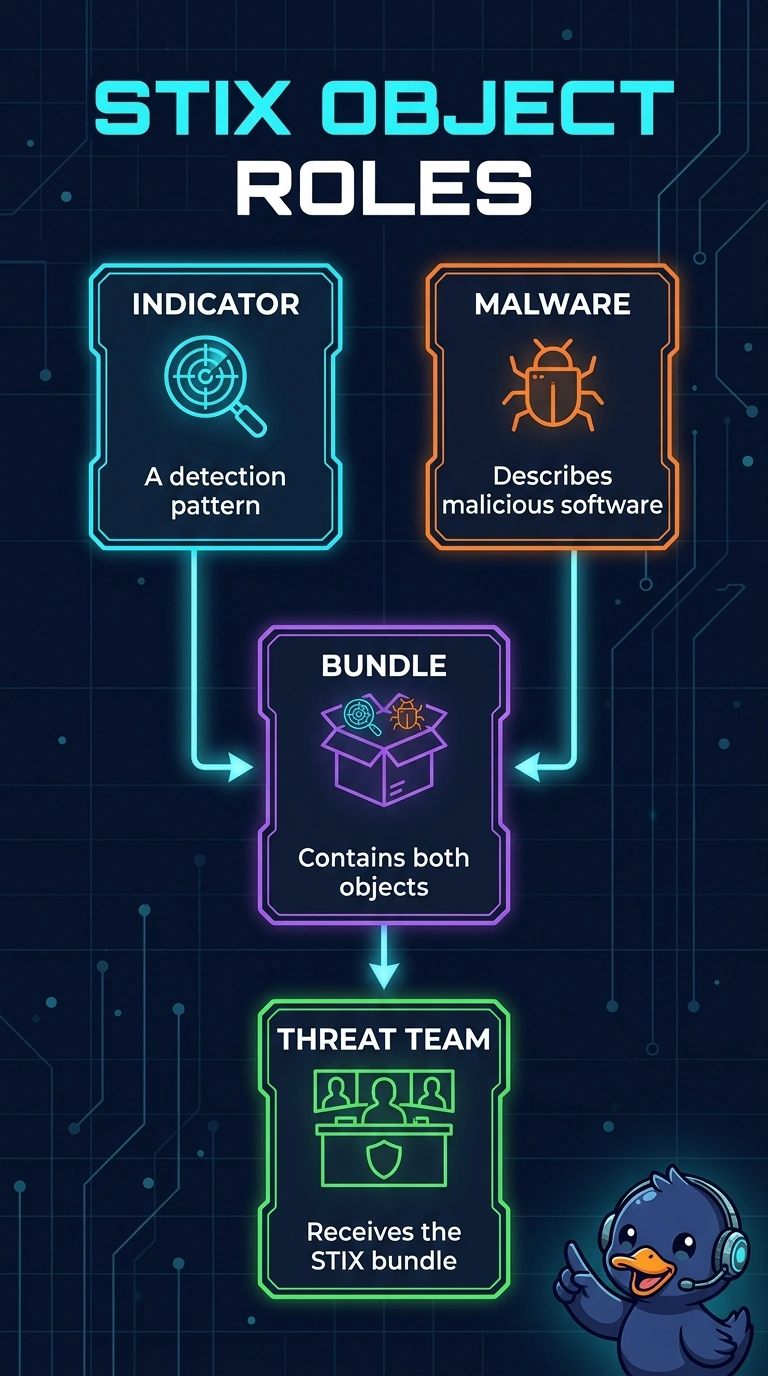
A hospital threat team receives a STIX bundle that contains one indicator object and one malware object. What does each object represent?
Select an answer to reveal the explanation.
Short Explanation
You can keep the two roles straight: an indicator gives you a pattern to detect, while a malware object describes the malicious software itself. They can travel together in a bundle without becoming the channel that delivered it.
Full Explanation
STIX gives each object type its own job, even when two objects appear in the same bundle. An indicator is a detection pattern: the test your team can hunt for or use to alert. A malware object describes the malicious software itself, such as its family name and traits. Treating the indicator as the transport channel and the malware object as the collection that stores records confuses these objects with TAXII functions: a collection holds objects, and transport moves them, but neither object is the pipe. Treating the indicator as a sponsor identity and the malware object as a place for motivation and goals assigns actor traits to the wrong types; sponsorship and motivation belong to a threat-actor object, not to a detection pattern or software description. Treating the indicator as a firewall rule and the malware object as a host-isolation playbook step confuses intelligence with enforcement. Blocking and isolation are decisions made after you understand the objects, not what the objects represent. Exam caveat: a relationship may link an indicator to malware in the same bundle, but that link is a third object and does not redefine either one. Practical check: open the bundle and confirm the indicator contains a pattern and the malware object describes the software, rather than a feed address or firewall action.