
A school district wants to take in a partner intelligence feed. Why configure a TAXII collection, and what does that configuration step not accomplish?
Select an answer to reveal the explanation.
Short Explanation
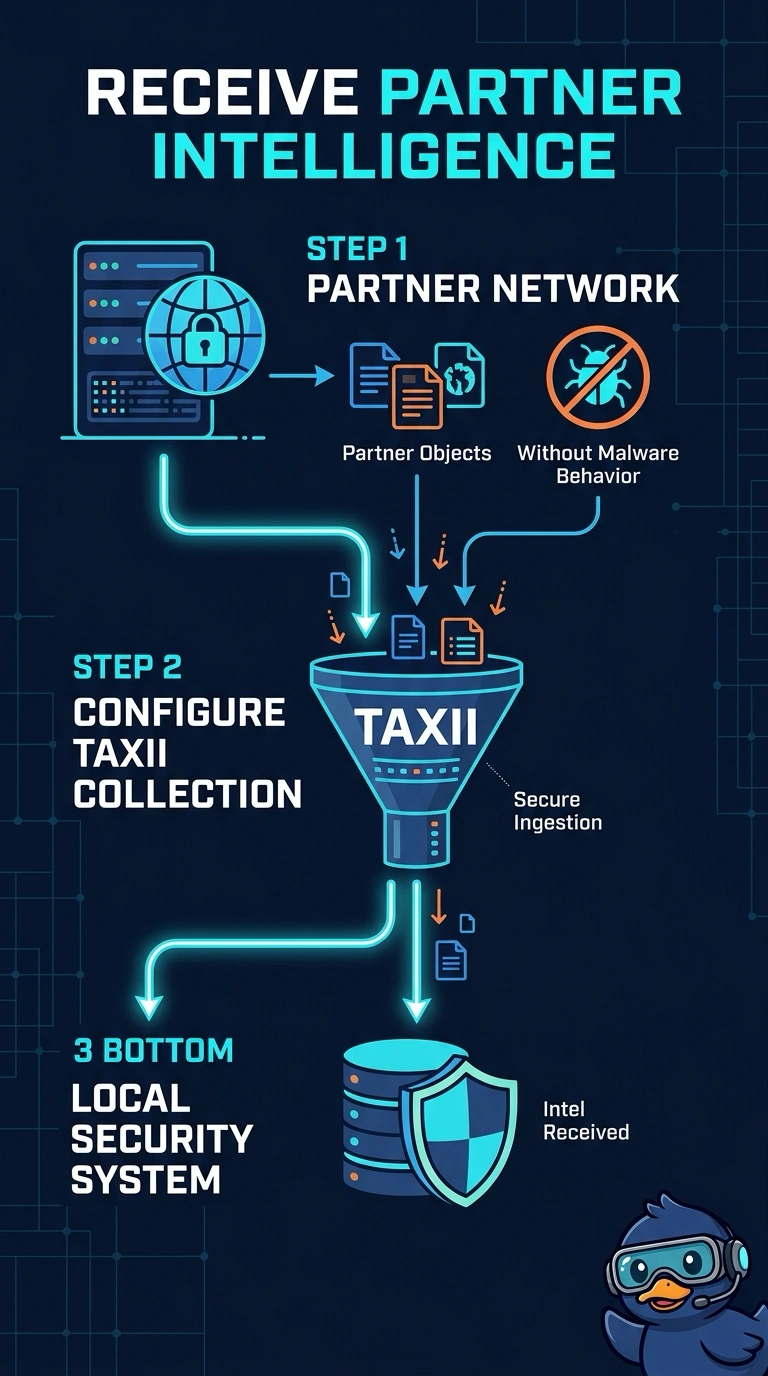
A mailbox can deliver a letter, and the mailbox is not the diagnosis written inside it. You configure a TAXII collection so the partner objects arrive, and that step does not describe how the malware behaves. The trap is expecting the collection setup to stand in for a malware description.
Full Explanation
TAXII is the transport. A collection is the set of STIX objects a partner exposes, and configuring a client against that collection is how the district receives those objects. Configure a TAXII collection to receive the partner objects, without describing malware behavior: the setup moves intelligence, and any description of behavior sits inside an object that was retrieved, usually a malware object. Authoring the collection so it documents capabilities and network behavior in place of a malware object treats the mailbox as the letter. Naming the collection so that name becomes the indicator pattern enforced by the firewall confuses a collection title with a detection pattern, and a firewall still needs a translated control. Storing actor motivation and confidence on the collection in place of a threat-actor object puts actor traits on the transport instead of on a threat-actor object. Exam caveat: objects that arrive are not yet a block or an isolation rule; someone still has to turn a useful indicator into a control the firewall or endpoint can enforce. Operational check: confirm the client is pointed at the partner collection, then open a retrieved malware object and show that the behavior text lives there, not in the collection configuration.