
A SOC queue has two Secure Malware Analytics samples, and only one carries a high threat score. What is that score for, and why do the indicators still get read?
Select an answer to reveal the explanation.
Short Explanation
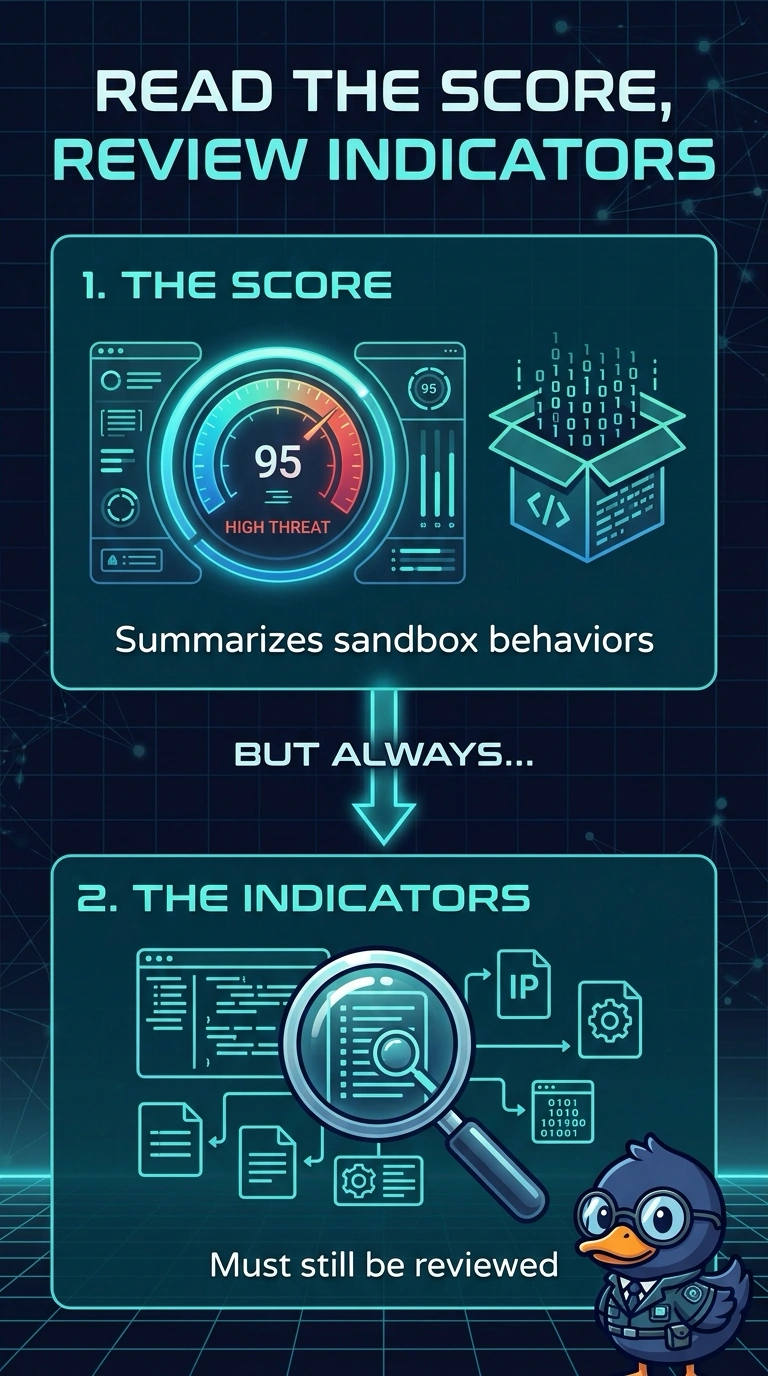
You can use the threat score as a summary of what the sandbox observed, not as a final ruling or proof of execution on enterprise hosts. You still review the indicators for both samples, including the lower-scored one, because they show the behaviors behind the score and guide your hunt.
Full Explanation
In Secure Malware Analytics, the threat score summarizes behavioral indicators observed while a sample ran in the sandbox. You read it as a summary of sandbox behaviors and still review the indicators to understand which actions, files, and network touches are behind the number and what to hunt. Treating the score as a final ruling that removes any need to read the behaviors discards the detail that tells you what the sample did. Reading a high score as proof the sample already executed on enterprise hosts confuses a sandbox detonation with a production sighting; the score describes the sandbox run, not your fleet. Dropping the lower-scored sample from the queue unread treats a quieter summary as if it cleared the sample, but its indicators can still show useful behavior, and the score is not a safety certificate. Exam caveat: do not invent a numeric cutoff that lets you skip indicators; the score helps prioritize attention but still points back to the behaviors. Practical check: open the indicator list for both samples and note the behaviors you would search for, using the score only to decide which report to open first.